Field Trips & Workshops
Paleontology & Earth Science Field Trip Hub
Educator Quick Menu:
Earth & Paleontology: In-Museum Expeditions
Step out of the classroom and directly into deep time! Excavate the mysteries of a changing planet, map ancient landscapes, and stand face-to-face with legendary prehistoric giants inside our world-class exhibition halls and prep labs.Bring the history of our planet to life where it belongs—in the palm of your hand! In these highly immersive, in-museum field trip expeditions, Burpee’s expert geologists and paleontologists guide your students through our master earth science galleries and active laboratories. By pairing guided gallery tours with hands-on STEM lab investigations, students will look the ancient past right in the eye, literally. They will study microscopic mineral structures under high magnification, track tectonic forces that deformed regional landscapes, and handle real dinosaur bones, ancient marine fossils, and prehistoric ice age megafauna to discover how Earth masterfully evolves across millions of years.
Booking Details & Logistics:
- Target Audience: Programs are custom-tailored for all age levels, from Pre-K through High School and adults. From assisted living centers to community events.
- Flexible Formats: Available as small-group classroom workshops, rotating setups, or large auditorium assemblies.
- Travel Range: Proudly serving Rockford, the surrounding Winnebago County, and regional school districts.
🦎 Our Earth Science Programs:
Click the title to jump to descriptions and standards!
Fossil & Dino Expedition: Journey Through Deep Time
Key Concepts: Fossilization mechanics, geological deep time, species variation, Carboniferous vs. modern flora, paleontology excavation methods, and skeletal pathology analysis.
Step onto the timeline of our planet!
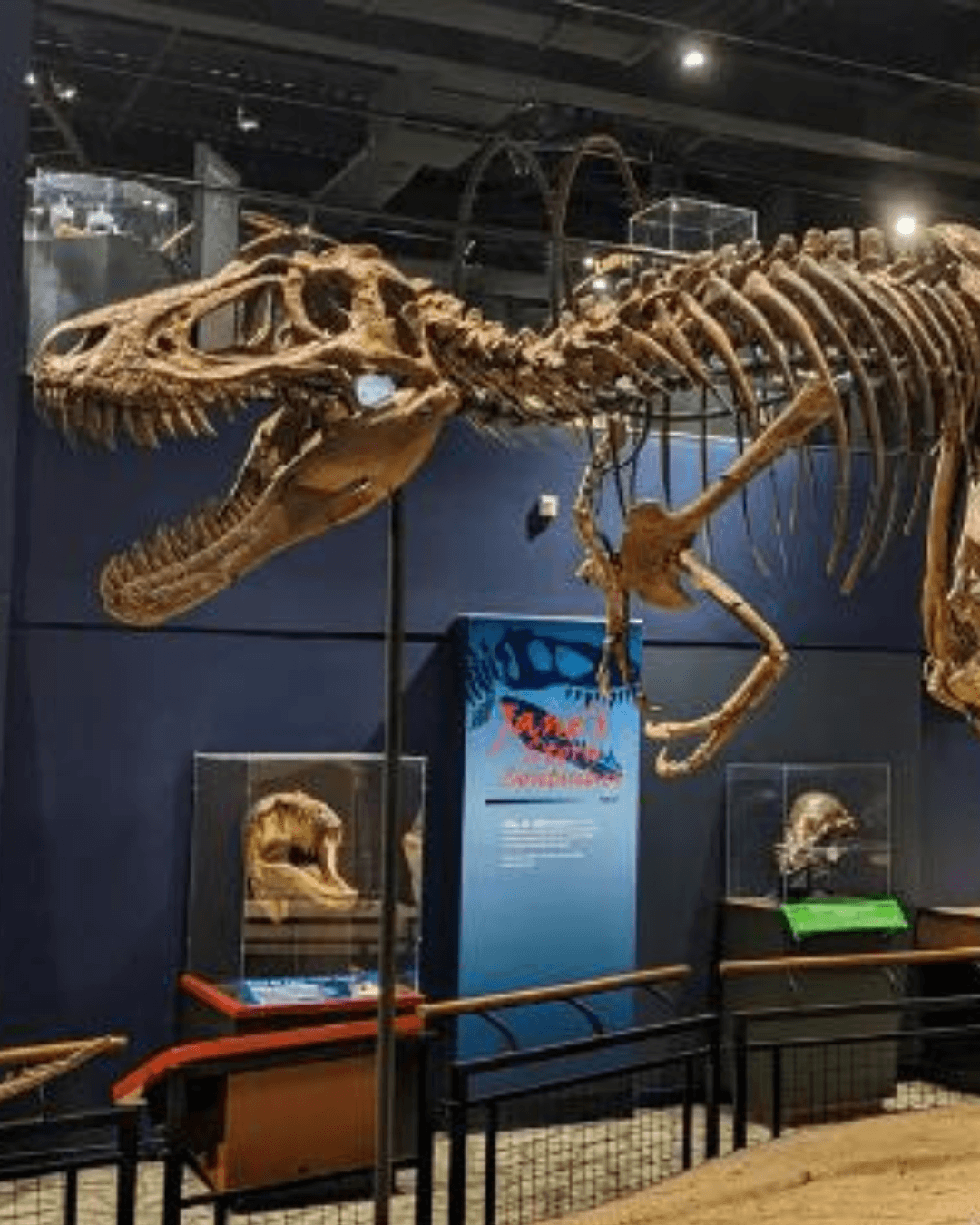
All Ages & Grades (Featuring DinoMite! tracks for early learners) Trace Earth’s history from an ancient sea that once covered Rockford to the age of legendary giants like Stegosaurus, Triceratops, and Jane, our world-famous therapod. Walk through the museum’s beautiful corridors of history! In this guided museum expedition, a Burpee paleontologist or expert educator leads your students on a journey across millions of years. For younger classrooms (Grades 2 & Under), our specialized DinoMite! track introduces the wonder of prehistoric giants through age-appropriate storytelling. Older students (Grades 3 & Up) dig into professional field techniques, handling authentic fossils, navigating a life-sized Carboniferous coal forest recreation, exploring active Jurassic dinosaur bone beds, and analyzing real bone pathology data to decode how ancient dinosaurs lived and died.
🎓 Curriculum Alignment Matrix (K-12 Grade Tracks)
Our curriculum adaptively shifts terminology, difficulty, and hands-on activities based on the targeted age group to hit key standard benchmarks:
🧩 Early Learners (Grades K – 2): Prehistoric Shapes, Teeth, & Shells (DinoMite! Track). Young students focus on observing basic features of fossils. By sorting ancient marine life (crinoids, corals, and snails), inspecting footprint casts, and matching diverse teeth shapes to diets, early learners discover how ancient animals used hard structures like shells and armor for protection.
Core Focus: Basic fossil formation, animal survival needs, tracking movement, and prehistoric habitats.
Standards Unlocked & How We Do It:
- K-ESS3-1: Sorting and handling varied prehistoric specimens to model how ancient animals interacted with their micro-environments to find food and shelter.
- 1-LS1-1: Examining the physical traits of giant dinosaurs—such as sharp claws, defensive plates, or long necks—to identify how ancient organisms used external structures to navigate their environments.
- 2-LS4-1: Observing and sorting ancient specimens from our collections to compare biodiversity differences between distinct prehistoric epochs.
🔍 Elementary Minds (Grades 3 – 5): Rock Layers, Chronology, & Ecosystem Shifts. Upper-elementary students investigate biological evolution, and rock layer configurations. Students analyze how the fossil record acts as a timeline of environmental change, exploring how rock layers bury older fossils beneath newer ones.
Core Focus: Carboniferous ecosystems, structural adaptations, indices of fossil horizons, and trophic interactions in ancient food webs.
Standards Unlocked & How We Do It:
- 3-LS4-1 & 3-LS4-3: Analyzing and interpreting data from fossil specimens to discuss concrete evidence of long-past environments, assessing traits that gave certain organisms survival advantages over others.
- 4-ESS1-1 & 4-LS1-1: Utilizing regional rock formations and index fossil horizons to map temporal change, and investigating internal and external skeletal structures that supported survival.
- 5-LS2-1 & 5-LS1-1: Developing visual models of ancient interdependent food webs, tracking energy from Carboniferous flora down to decomposers.
🔬 Middle & High School (Grades 6 – 12): Taphonomy, Cladistics, & Extinction Dynamics. Older students explore taphonomy to analyze what happens to an organism between death and discovery, utilize cladistics to visualize evolutionary relationships (such as tracing theropod lineages to modern birds), and evaluate global mass extinction boundary events using stratigraphic data.
Core Focus: Paleoecollogy, taphonomic biases, micro-vertebrate data collection, CT bone imaging
Standards Unlocked & How We Do It:
- MS-LS4-1 & HS-LS4-1: Interrogating fossil matrices to document the existence, diversity, rapid decline, and extinction of major life forms throughout deep time, and in the late Cretaceous.
- MS-LS4-2 & HS-LS4-2: Applying anatomical data from modern and fossilized skeletons to discuss phylogenetic hypotheses of common ancestry links.
Dynamic Earth: Earth’s Forces & Beneath Your Feet
Key Concepts:he rock cycle, compaction, weathering and erosion, metamorphic/igneous/sedimentary rock identification, basic mineral chemistry, and crystalline impurities.
Let us show you why rocks really rock!
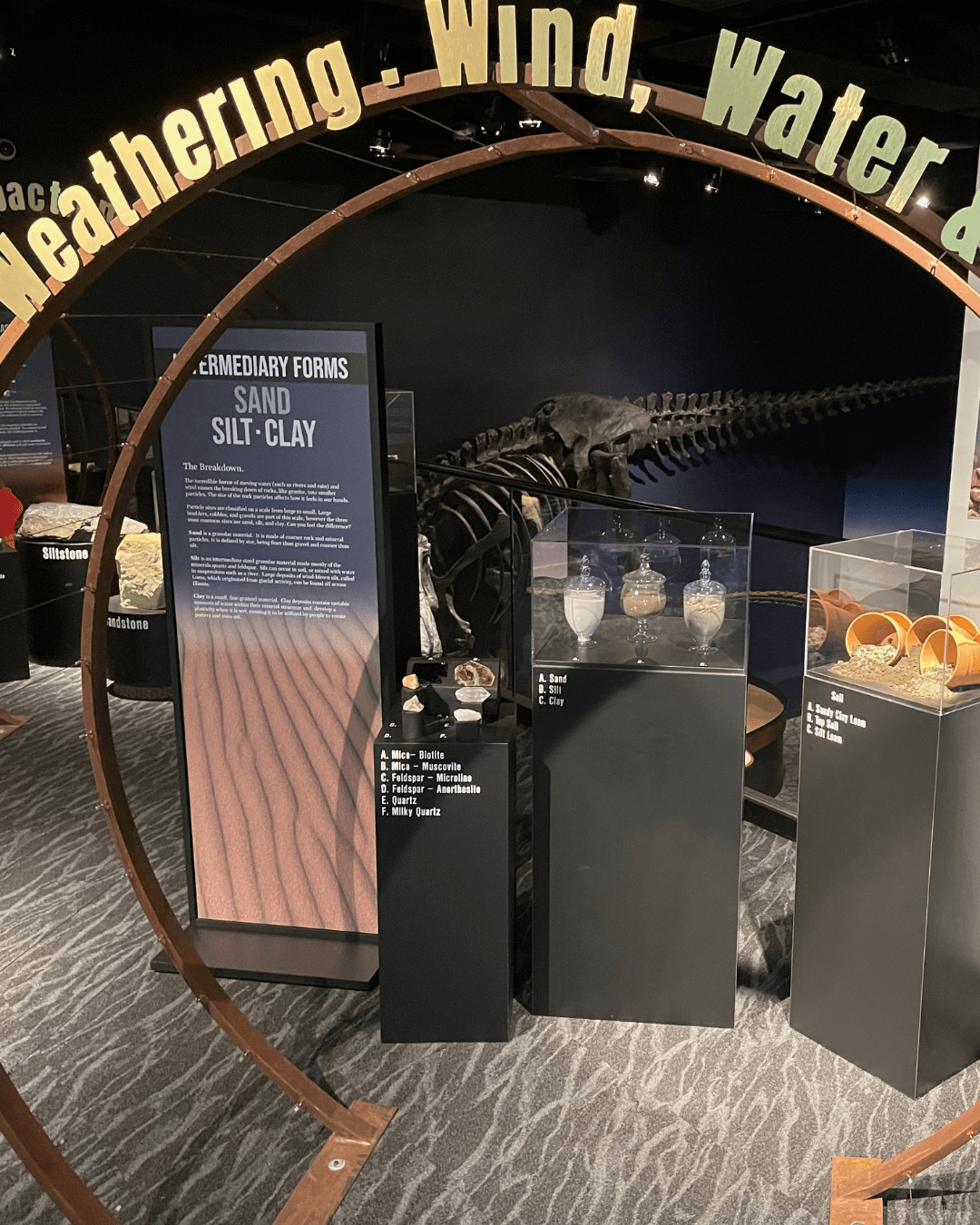
Follow minerals as they are transformed by intense temperature, massive tectonic shifts, and crushing compaction miles under the surface of the Earth.Unearth the raw power of a changing planet! In this highly immersive guided museum expedition, an expert Burpee geologist or educator leads your students on a subterranean trek. For younger classrooms (Grades 2 & Under), our specialized Beneath Your Feet track introduces early learners to basic earth materials by holding real specimens and cracking open beautiful minerals. Older students (Grades 3 & Up) tackle the Earth’s Forces track, charting transitions from liquid magma to the products of slow and rapid cooling, investigating weathering by wind and water, and analyzing how chemical impurities give crystals their vibrant, glowing colors.
🎓 Curriculum Alignment Matrix (K-12 Grade Tracks)
Our curriculum adaptively shifts terminology, difficulty, and hands-on activities based on the targeted age group to hit key standard benchmarks:
🧩 Early Learners (Grades K – 2): Colors, Crystals, & Soil Layers (Beneath Your Feet Track). Young students use their senses to observe, sort, and classify natural earth materials. By grouping specimens by luster, and studying what makes up local soil, early learners discover how water and wind shape the surface of the land.
Core Focus: Sorting by physical attributes (shiny, rough, smooth), identification games, basic erosion, and beach/dirt compositions.
Standards Unlocked & How We Do It:
- 2-ESS1-1: Comparing varied rock samples collected from distinct geographic regions to identify physical evidence of fast and slow changes happening on Earth’s surface.
- K-2-ETS1-2: Looking at different physical rocks and crystal sizes to examine how properties dictate appearance.
🔍 Elementary Minds (Grades 3 – 5): Cooling Rates, Weathering, & Rock Transitions. Upper-elementary students investigate how rocks break down and transform over deep time. Students trace intermediary rock forms from solid cliffs down to beach sand and dirt, examining how weather and living organisms affect minerals.
Core Focus: Igneous, sedimentary, and metamorphic pathways; products of quick vs. slow cooling; and weathering forces.
Standards Unlocked & How We Do It:
- 4-ESS1-1: Evaluating patterns inside exposed limestone and sandstone strata exhibits to explain how the local landscape shifted between marine environments and terrestrial dunes over millions of years.
- 5-ESS2-1: Exaining how the geosphere, hydrosphere, and biosphere interact by tracing how groundwater chemistry deposits impurities that color crystalline structures and cement sedimentary stones, and produces beautiful agate.
🔬 Middle & High School (Grades 6 – 12): Tectonic Mechanics, Chemical Crystallization.
Icy Illinois Tour: The Rockford Ice Age
Key Concepts:Glacial geology, Pleistocene megafauna, survival traits, comparative skull anatomy, extinction vs. survivorship, and early human hunting dynamics.
It was freezing cold in ancient Rockford!
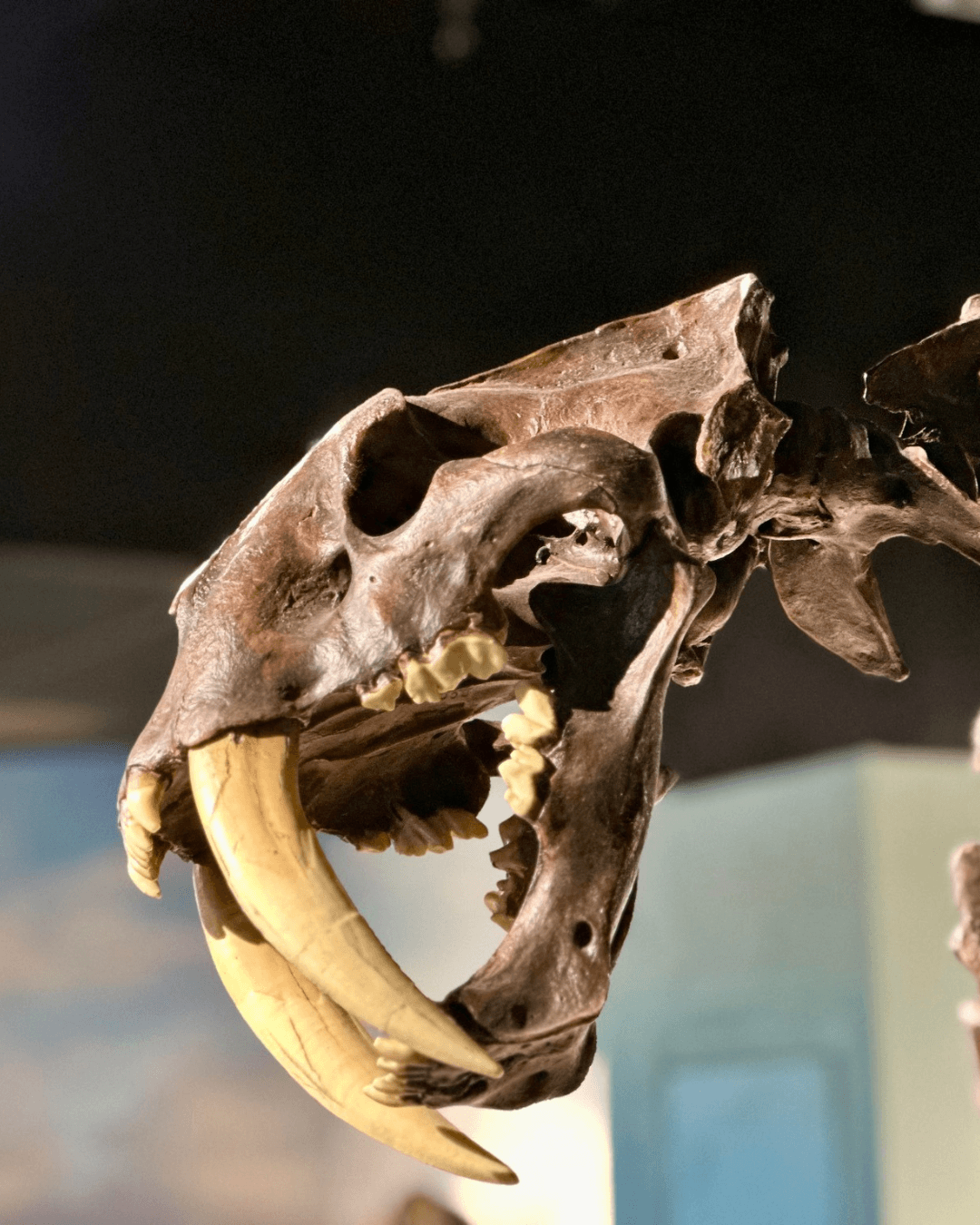
Burrrrr! Journey back in time to an Illinois landscape ruled by Mammoths, Saber-Tooth Cats, and Giant Beavers, and discover how massive glaciers sculpted the midwestern land we see today.Travel back to a landscape that looked radically different than it does today! In this highly interactive in-museum field trip expedition, an expert Burpee educator guides your students through the frozen Pleistocene epoch. By stepping directly into our Ice Age galleries, handling authentic megafauna teeth, examining thick insulation fur, and comparing the skeletal anatomy of extinct monsters to modern-day survivors, students will uncover how geological forces and extreme climates drive the evolution and extinction of life.
🎓 Curriculum Alignment Matrix (K-12 Grade Tracks)
Our curriculum adaptively shifts terminology, difficulty, and hands-on activities based on the targeted age group to hit key standard benchmarks:
🧩 Early Learners (Grades K – 2): Feathers, Beaks, & Nests. Young students use their senses to observe the basic external parts of a bird. By touching real feathers or bird feet, and looking at varied beak shapes, they will discover how feathers keep birds warm and dry, and how different shapes of beaks help them eat different foods.
Core Focus: Basic body parts (wings, beaks, feathers), camouflage vs. bright colors, and how birds care for their young.
Standards Unlocked & How We Do It:
- K-LS1-1: Observing and sorting museum specimens to match what different birds eat with the shape of their beaks.
- 1-LS1-1: Examining feather structures under a magnifying glass to see how they act as natural raincoats and blankets for survival.
- 2-LS4-1: Comparing taxidermy specimens of water birds (like ducks) and forest birds (like woodpeckers) to see how their traits match their homes.
🔍 Elementary Minds (Grades 3 – 5): Skeletal Engineering & Aerodynamics. Upper-elementary students investigate internal structures and the mechanics of flight. By holding real bird bones, they compare the weight of dense mammal bones to hollow avian bones. They also test how different feather shapes create lift and thrust.
Core Focus: Hollow bone structures, feather anatomy (barbs and barbules), beak specialization (the “tools” of the ecosystem), and migration patterns.
Standards Unlocked & How We Do It:
- 3-LS4-3: Analyzing data from our beak-and-tool simulation to prove how specific beak shapes give birds a survival advantage over others.
- 4-LS1-1: Investigating internal systems—like air sacs and hollow, fused skeletons—that function together to make flight physically possible.
- 5-LS2-1: Modeling how birds of prey act as consumers that transfer energy and keep rodent/insect populations balanced in food webs.
🔬 Middle & High School (Grades 6 – 12): Theropod Evolution & Functional Anatomy. Older students engage in advanced evolutionary biology and physics. They examine the skeletal similarities between modern birds and avian dinosaurs (theropods), analyze the mechanics of the avian respiratory system, and study how environmental pressures drive rapid beak evolution.
Core Focus: Avian evolution from dinosaurs, homologous structures, physics of lift/drag, ecological indicators, and population genetics.
Standards Unlocked & How We Do It:
- MS-LS4-2 & HS-LS4-2: Comparing the skeletal structures of modern birds to fossil records to find anatomical evidence of evolutionary relationships to theropod dinosaurs.
- MS-LS1-4: Using museum specimens to explain how specialized behaviors (like complex bird songs) and physical structures (like plumage) increase successful reproduction.
- HS-LS2-7: Evaluating how modern environmental challenges (like light pollution and climate-shifted migration timelines) threaten avian populations, and reviewing conservation designs.
Field Trip Pricing and Logistics
In-Person Tours:
- $7.00 per student
- $5.00 flat fee for chaperones
- All staff are free of charge
- $5.00 per class lunchroom fee
- 60 minutes per tour
- $1.00 per student for extra exploration time
- Lab/Workshops add-ons are an extra charge
- Lunchroom can be reserved (ask for details)
Virtual Tours:
- $5.00 per student (Teachers are not charged)
- About 45 minutes per tour
- PLUS FREE UNLIMITED explore time after the tour (same month, same group. Teachers are no charge)
Virtual visits can be scheduled for AM, PM, or both, AND include a Burpee guide.
Contact Us: For more important information about bringing your group to Burpee, contact us at 815-965-3433 Or By Email: nicole.hayes@burpee.org