Traveling Science
Earth, Chemistry & Paleontology Outreach Hub
Educator Quick Menu:
Bringing Paleontology, Earth, and Chemical Sciences
Directly to You
Booking Details & Logistics:
- Target Audience: Programs are custom-tailored for all age levels, from Pre-K through High School and adults. From assisted living centers to community events.
- Flexible Formats: Available as small-group classroom workshops, rotating setups, or large auditorium assemblies.
- Travel Range: Proudly serving Rockford, the surrounding Winnebago County, and regional school districts.
🦎 Our Peoples & Cultures Programs:
Click the title to jump to descriptions and standards!
The Science of Paleontology
Key Concepts: Fossilization processes, geologic deep time, sedimentary stratification, comparative anatomy, extinction events, and taphonomy.
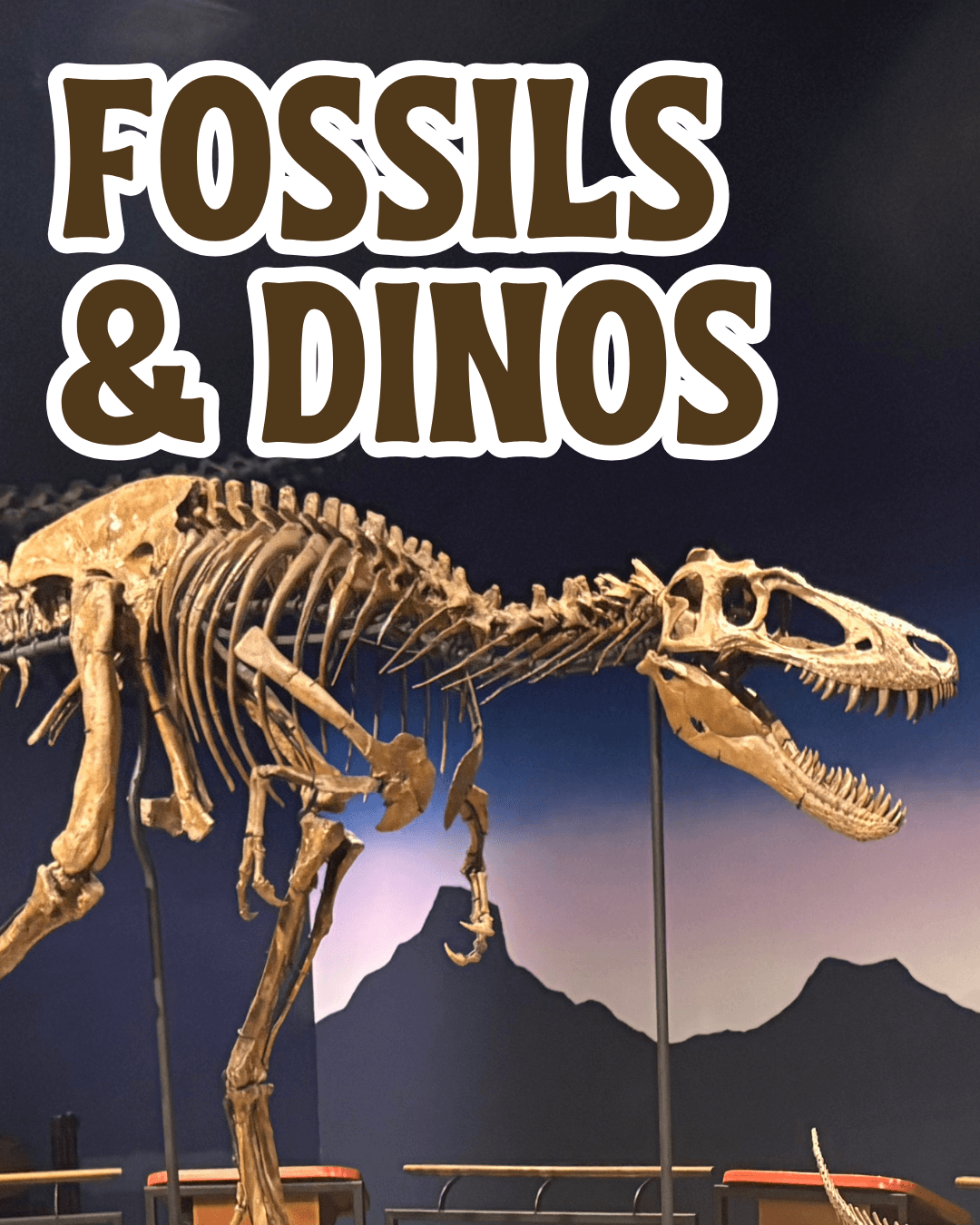
Uncover the mystery of how fossils form, explore the prehistoric eras of Illinois, and discover what made giants like Jane the so unique using incredible museum specimens. Bring a world-class paleontological knowledge straight to your door! In this highly interactive mobile museum experience, a Burpee educator guides students through the deep history of life on Earth. You will handle real, million-year-old fossils, analyze cast replicas of massive dinosaur skeletons, and learn the scientific methods that Burpee researchers use out in the field to decode the prehistoric world.
Tactile Specimen Station: An extensive collection of real museum fossils and high-fidelity casts! Explore real 450-million-year-old local marine fossils, a Triceratops frill and horn fragments, trilobites, fossilized teeth and more!
🎓 Curriculum Alignment Matrix (K-12 Grade Tracks)
Our curriculum adaptively shifts terminology, scientific depth, and hands-on activities based on the targeted age group to hit key standard benchmarks:
🧩 Early Learners (Grades K – 2): Clues from the Past! Young students use their observational skills to explore what a fossil is and how it acts as a clue to an animal that lived long ago. By examining tooth shapes and footprint casts, they will discover how scientists figure out what a dinosaur ate and how it moved.
Core Focus: Sharp vs. flat teeth (diet), basic fossil formation, and prehistoric animal survival needs.
Standards Unlocked & How We Do It:
- K-ESS3-1: Modeling how prehistoric animals interacted with their ancient environments to meet their physical survival needs.
- 1-LS1-1: Identifying how dinosaurs used external structures (like sharp claws, armor plates, or long necks) to protect themselves and gather food.
- 2-LS4-1: Observing and sorting ancient specimens to compare the diversity of life between different prehistoric epochs.
🔍 Elementary Minds (Grades 3 – 5): Rock Layers, Evolution, & Ancient Habitats. Upper-elementary students investigate how the fossil record acts as a timeline of environmental change. They explore how rock layers bury older fossils beneath newer ones, analyze how regional climates shifted over time (like when Illinois was covered by a tropical sea), and simulate how structural adaptations gave certain species a survival advantage.
Core Focus: Geologic stratification, index fossils, environmental transitions, structural adaptations, and ancient food webs.
Standards Unlocked & How We Do It:
- 3-LS4-1: Analyzing and interpreting data from fossil specimens to provide evidence of the organisms and environments that existed long ago.
- 4-ESS1-1: Identifying evidence from rock formations and fossil patterns to explain how a landscape shifted over millions of years.
- 5-LS2-1: Modeling prehistoric food webs to describe how energy moved through ecosystems during the age of the dinosaurs.
🔬 Middle & High School (Grades 6 – 12): Taphonomy, Cladistics, & Macro-Evolution. Older students engage in professional-grade paleontology. They study taphonomy to analyze what happens to an organism between death and discovery, utilize cladistics and anatomical data to map evolutionary relationships (such as tracing theropod dinosaurs to modern birds), and evaluate global mass extinction events using stratigraphic data.
Core Focus: Cladograms and phylogenetic trees, taphonomic biases, radioactive dating principles, mass extinction boundary events, and morphological variations in growth series (like juvenile vs. adult apex predators). And of course, hands on interactions with dino fossils as well!
Standards Unlocked & How We Do It:
- MS-LS4-1 & HS-LS4-1: Analyzing patterns within the fossil record to document the existence, diversity, and extinction of major life forms throughout geologic time.
- MS-LS4-2 & HS-LS4-2: Applying anatomical data from modern and fossilized skeletons to construct phylogenetic hypotheses and verify common ancestry links.
- HS-ESS1-6: Evaluating evidence from ancient strata and radioactive decay data to construct a comprehensive timeline of continental and regional crustal history.
Megafauna & Frozen Landscapes
Key Concepts: Glacial geology, climate shifts, megafauna adaptations, predator-prey dynamics of the Pleistocene, extinction theories, and local Illinois geologic formations.
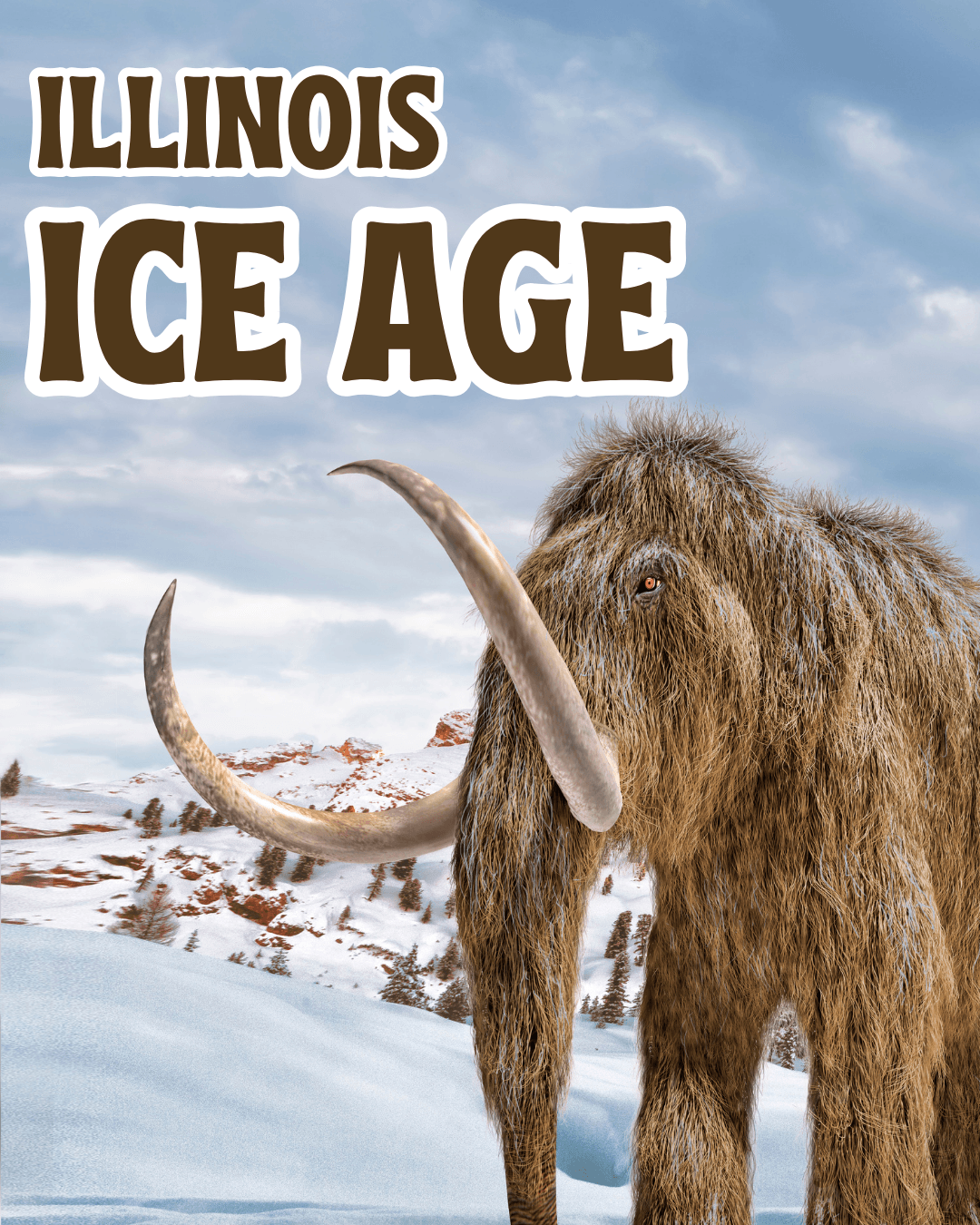
Uncover the massive creatures that once roamed our state, handle genuine megafauna fossils, and discover how massive carving glaciers sculpted the modern Illinois landscape.Travel back to a time when Illinois was covered by giant sheets of ice! In this highly immersive mobile museum experience, a Burpee educator takes your students on an expedition to the Pleistocene epoch.
Tactile Specimen Station: A collection of authentic Ice Age fossils and high-fidelity casts, including a Mammoth tooth, a Giant Beaver skull replica, saber-toothed cat jaw cast, and glacier-carved “striation” rock specimens found right here in the Midwest.
🎓 Curriculum Alignment Matrix (K-12 Grade Tracks)
Our curriculum adaptively shifts terminology, scientific depth, and hands-on activities based on the targeted age group to hit key standard benchmarks:
🧩 Early Learners (Grades K – 2): Big Animals, Warm Coats. Young students use their senses to explore how giant Ice Age animals stayed warm in the freezing cold. By touching thick fur specimens and comparing the sizes of ancient teeth to modern animals, they will discover how massive mammals found food and survived in the snow.
Core Focus: Insulation (fur/fat), basic needs of winter animals, giant vs. small sizes, and tracing ancient footprints.
Standards Unlocked & How We Do It:
- K-ESS3-1: Modeling how Ice Age megafauna used natural features of the frozen tundra to find shelter and resources.
- 1-LS1-1: Identifying how creatures like the Woolly Mammoth used external structures (like curved tusks for sweeping snow and thick undercoats) to stay safe.
- 2-LS4-1: Comparing the giant mammals of prehistoric frozen Illinois to the wildlife living in our local habitats today.
🔍 Elementary Minds (Grades 3 – 5): Glacial Carving & Ecosystem Collapses. Upper-elementary students investigate the colossal power of moving ice sheets. They explore how thousands of feet of glacial ice carved out the Great Lakes and flattened the Illinois terrain, analyze the specialized diets of Mammoths vs. Mastodons, and study how rapid climate warming drove these giants to extinction.
Core Focus: Glacial weathering and erosion, browser vs. grazer dentition, environmental shifts, and Pleistocene food webs.
Standards Unlocked & How We Do It:
- 3-LS4-1: Analyzing fossil teeth and bones to determine what prehistoric Illinois looked like and proving it was once a cold steppe-tundra.
- 4-ESS2-1: Modeling how moving glaciers acted as a massive force of erosion, grinding down rocks and carving the physical geography of the Midwest.
- 5-LS2-1: Examining a food web model to describe the collapse of the Ice Age ecosystem when keystone vegetation shifted due to warming climates.
🔬 Middle & High School (Grades 6 – 12): Climate Cycles, Megafaunal Overkill, & Isotope Analysis. Older students engage in advanced quaternary science. They explore Milankovitch cycles (Earth’s orbital shifts) that trigger ice ages, evaluate competing scientific theories surrounding the Quaternary extinction event (climate change vs. human overkill), and explore how scientists use stable isotope data from fossil teeth to map ancient migration routes.
Core Focus: Milankovitch orbital cycles, taphonomy of tar pits and bogs, climate proxy data, megafaunal overkill hypothesis, and evolutionary bottlenecks.
Standards Unlocked & How We Do It:
- MS-LS4-1 & HS-LS4-1: Interrogating the recent fossil record to document the rapid decline and extinction of megafauna species at the close of the last glacial maximum.
- MS-ESS2-2 & HS-ESS2-5: Analyzing data on how glacial advances and retreats dramatically altered regional hydrology, soil distribution, and surface topography across North America.
- HS-LS2-7: Evaluating scientific evidence surrounding the impact of early human hunters on apex megafauna populations and drawing parallels to modern biodiversity challenges.
Rocks & Minerals: Dynamic Earth
Key Concepts: The rock cycle, mineral identification matrices, crystallization, plate tectonics, weathering/erosion, and economic geology.
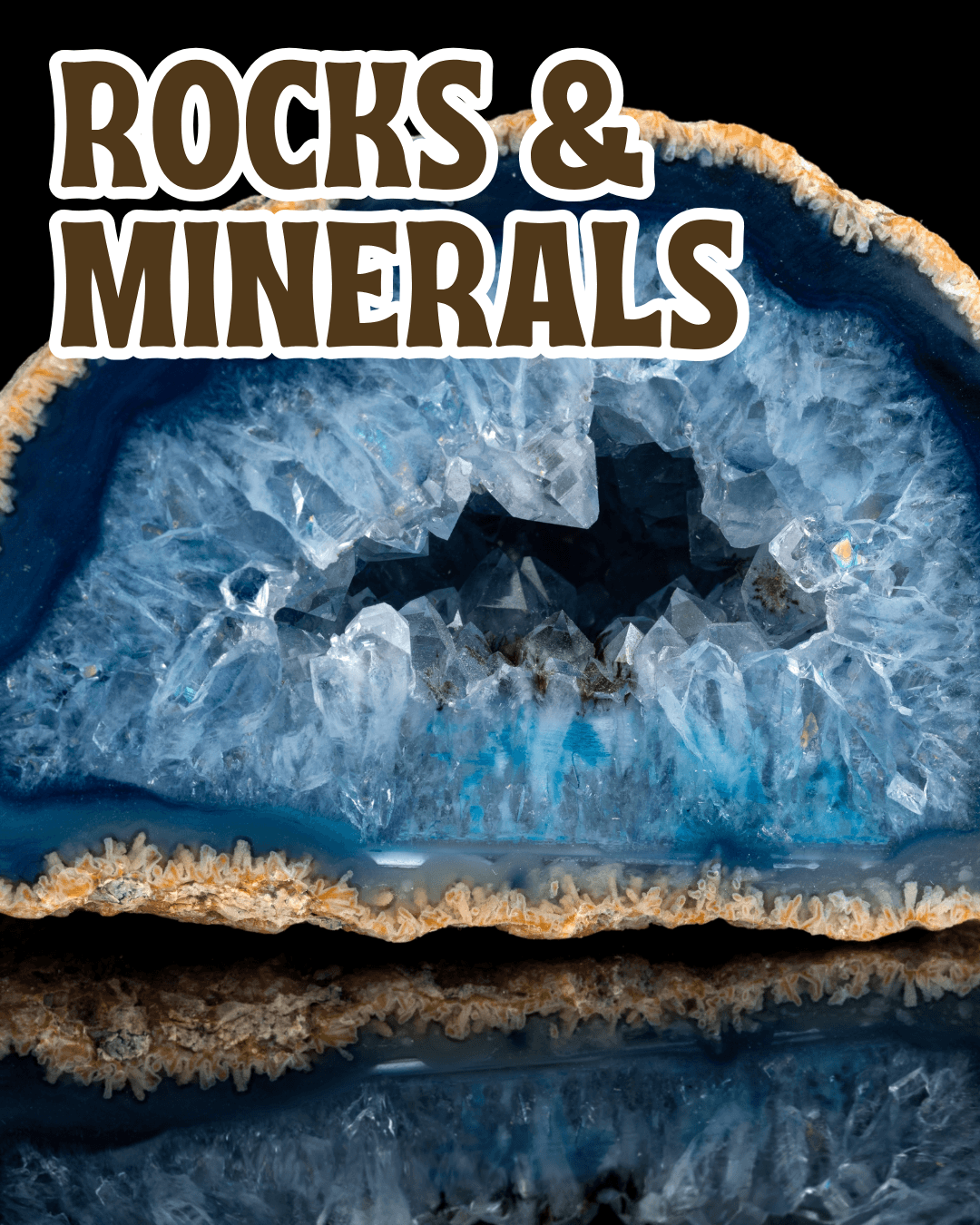
Investigate chemical properties, tectonic forces, and crystallization processes using incredible museum-grade mineral configurations and tactile geological specimens.Unearth the raw power of a changing planet! In this high-energy mobile museum experience, a Burpee geologist or expert educator guides your students through the fascinating lifecycle of the crust beneath our feet. Because this program focuses entirely on geological science, no live animals are involved. Instead, your students will perform acid scratch tests, use ultraviolet lights to discover glowing fluorescent minerals, and analyze real museum specimens to discover how heat, pressure, and time craft the building blocks of Earth.
Tactile Specimen Station: A collection of geological specimens, including volcanic obsidian, massive quartz crystal clusters, real raw copper veins, local Illinois limestone, impact meteorites, and a dark chamber station with ultraviolet lights for fluorescent minerals.
🎓 Curriculum Alignment Matrix (K-12 Grade Tracks)
Our curriculum adaptively shifts terminology, scientific depth, and hands-on activities based on the targeted age group to hit key standard benchmarks:
🧩 Early Learners (Grades K – 2): Colors, Crystals, & Scratching the Surface. Young students use their senses to observe, sort, and classify Earth’s natural materials. By grouping specimens by luster, testing hardness with simple tools, and hunting for hidden crystal shapes, early learners discover how water and wind shape the ground we walk on.
Core Focus: Sorting by physical attributes (shiny, rough, smooth), identification games, and basic erosion.
Standards Unlocked & How We Do It:
- K-ESS3-1: Sorting and handling varied local rocks to model how animals use earth materials like rocks, sand, and soil to build shelters and protect their microclimates.
- 1-PS1-1: Inspecting crystalline structures vs. glassy obsidian with hand lenses to discover how different cooling speeds dictate the physical state and features of matter.
- 2-LS4-1 / 2-ESS1-1: Analyzing rock samples collected from distinct regional river valleys to map how geological diversity creates unique local habitats for wildlife.
🔍 Elementary Minds (Grades 3 – 5): The Rock Cycle & Chemical Clues. Upper-elementary students dive into the mechanics of the rock cycle and the systematic identification of minerals. Students utilize professional testing methods, including streak plates, hardness tests, and mild acid reactions, to solve a geological mystery matrix.
Core Focus: Igneous, sedimentary, and metamorphic pathways; Mohs hardness scale; chemical properties of minerals; and weathering.
Standards Unlocked & How We Do It:
- 3-5-ETS1-1: Solving an engineering design challenge by identifying an unknown mineral using a strict testing matrix (streak plates, Mohs hardness picks, and magnet tests).
- 4-ESS2-1: Simulating weathering and water erosion using dynamic rock tumbling exercises to observe how massive stone structures break down into regional sand, soil, and clay.
- 5-PS1-3: Conducting chemical testing on limestone and calcite specimens to observe acid reactions, proving that specific minerals can be identified by testing their chemical properties.
🔬 Middle & High School (Grades 6 – 12): Tectonic Forces, Petrography, & Crystallization Physics. Older students engage in advanced earth sciences, analyzing the crystalline lattice configurations of minerals, tracking how heat and tectonic pressure recrystallize elements, and exploring how radioactive isotope distribution inside strata dates Earth’s history.
Core Focus: Atomic structure of crystals, subduction zone thermodynamics, igneous crystallization speeds, silicates vs. non-silicates, and economic mineral extraction.
Standards Unlocked & How We Do It:
- MS-PS1-2 & HS-PS1-2: Activating fluorescent minerals in an ultraviolet light chamber to investigate how unique molecular configurations dictate specific optical and chemical behaviors.
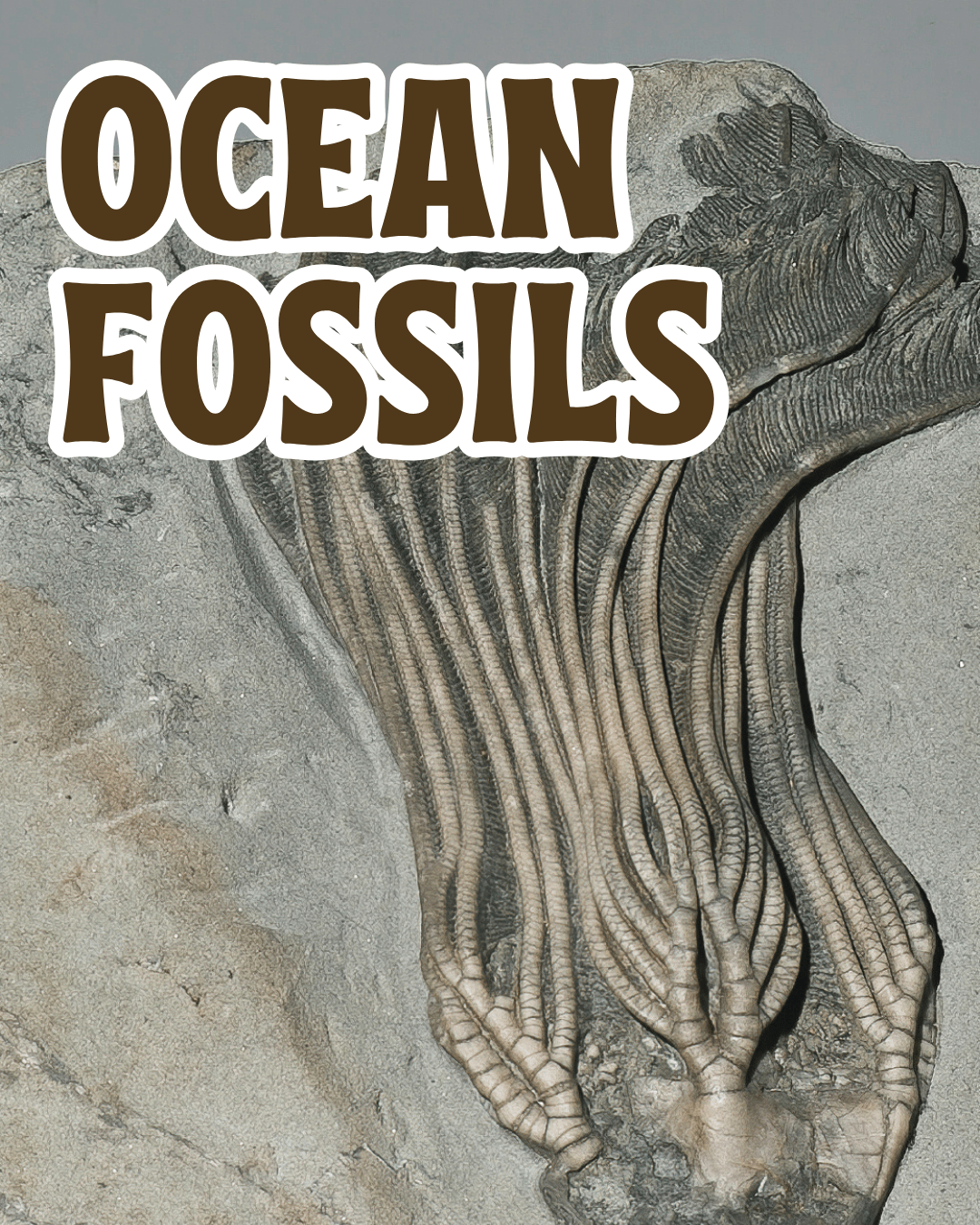
Ancient Seas of Illinois
Key Concepts: Ancient marine ecosystems, invertebrate anatomy, index fossils, environmental transitions (sea-level shifts), chemical sedimentation, and the evolutionary history of marine predators.
Dive into the ocean…
Dive into a 450-million-year-old tropical ocean right here in the Midwest! Uncover prehistoric marine ecosystems, examine bizarre ancient apex predators, and crack open fossilized reefs using extraordinary museum specimens.Long before dinosaurs roamed, Illinois was completely submerged under a warm, shallow tropical sea! In this highly immersive mobile museum experience, a Burpee paleontologist or expert educator takes your students on a deep-sea dive into our state’s marine past: from the Ordovician period to the unique Tully Monster ecosystems of the Mazon Creek beds. Students will get hands-on with real, ancient sea creatures to discover how modern Illinois was built by billions of prehistoric organisms.
Tactile Specimen Station: Our collection of authentic marine fossils and high-fidelity casts, including a massive straight-shelled cephalopods, ancient trilobites, delicate sea-lily (crinoid) columns, prehistoric shark teeth, brachiopods, fossilized coral reefs, and Illinois’ mysterious official state fossil, the Tullimonstrum gregarium (Tully Monster).
🎓 Curriculum Alignment Matrix (K-12 Grade Tracks)
Our curriculum adaptively shifts terminology, scientific depth, and hands-on activities based on the targeted age group to hit key standard benchmarks:
🧩 Early Learners (Grades K – 2): Shells, Swimmers, & Ancient Ocean Homes. Young students use their senses to explore the physical traits of ancient sea creatures. By handling fossilized shells and comparing ancient marine life to animals living in the ocean today, early learners discover how prehistoric creatures found food and stayed safe at the bottom of the sea.
Core Focus: Basic needs of marine life, shell armor, comparing prehistoric and modern sea animals, and tracing ancient ocean floor footprints.
Standards Unlocked & How We Do It:
- K-ESS3-1: Handling and sorting ancient fossilized clams and corals to examine how prehistoric marine organisms interacted with their ocean environment to find food and build shelters.
- 1-LS1-1: Examining the rigid, defensive structures of trilobite exoskeletons and brachiopod shells to identify how ancient invertebrates protected themselves from predators.
- 2-LS4-1: Sorting and classifying an assortment of marine biofacts to compare the diversity of life in an ancient, tropical Illinois sea to a modern coral reef habitat.
🔍 Elementary Minds (Grades 3 – 5): Fossilized Reefs & Vanished Environments. Upper-elementary students investigate how marine fossils act as a biological record of massive environmental shifts. They explore how finding ocean shells beneath the soil of landlocked Illinois proves that global sea levels have fluctuated dramatically, analyze how ancient food webs functioned without modern fish, and study how marine organisms form sedimentary rock layers.
Core Focus: Index fossils, sea-level transgression and regression, limestone formation, invertebrate anatomy, and prehistoric marine food webs.
Standards Unlocked & How We Do It:
- 3-LS4-1: Analyzing and interpreting data from crinoid, coral, and cephalopod fossils to evaluate evidence of the tropical, marine environments that existed in Illinois millions of years ago.
- 4-ESS1-1: Evaluating patterns in limestone strata and fossil distribution to explain how a regional landscape shifted from a deep ocean to dry, terrestrial land over geologic time.
- 5-LS2-1: Analyzing and critiquing a visual model of an ancient Ordovician marine food web to describe the movement of matter and energy from photosynthetic algae up to giant cephalopod apex predators.
🔬 Middle & High School (Grades 6 – 12): Taphonomic Preservation, Mass Extinctions, & Carbonate Chemistry. Older students engage in advanced quaternary and paleoceanographic science. They study the exceptional preservation conditions of the Mazon Creek ironstone nodules, analyze the Ordovician-Silurian mass extinction event driven by global cooling, and investigate how marine shell-building organisms regulate Earth’s carbon cycle through the formation of extensive limestone beds.
Core Focus: Lagerstätten preservation environments, soft-bodied fossilization, carbonate sedimentation chemistry, marine evolutionary radiations, and ocean acidification impacts in deep time.
Standards Unlocked & How We Do It:
- MS-LS4-1 & HS-LS4-1: Examining fossil matrices from marine horizons to identify the rapid decline, recovery, and macro-evolutionary radiation of marine invertebrates across major extinction boundaries.
- MS-ESS2-2 & HS-ESS2-5: Analyzing geochemical data and sedimentary rock patterns to explain how ancient marine life altered global hydrology, formed regional limestone aquifers, and trapped massive quantities of carbon in the crust.
- HS-LS2-7: Evaluating the structural collapse of ancient reef ecosystems during past ocean heating events to draw critical scientific parallels to modern marine conservation and biodiversity challenges.
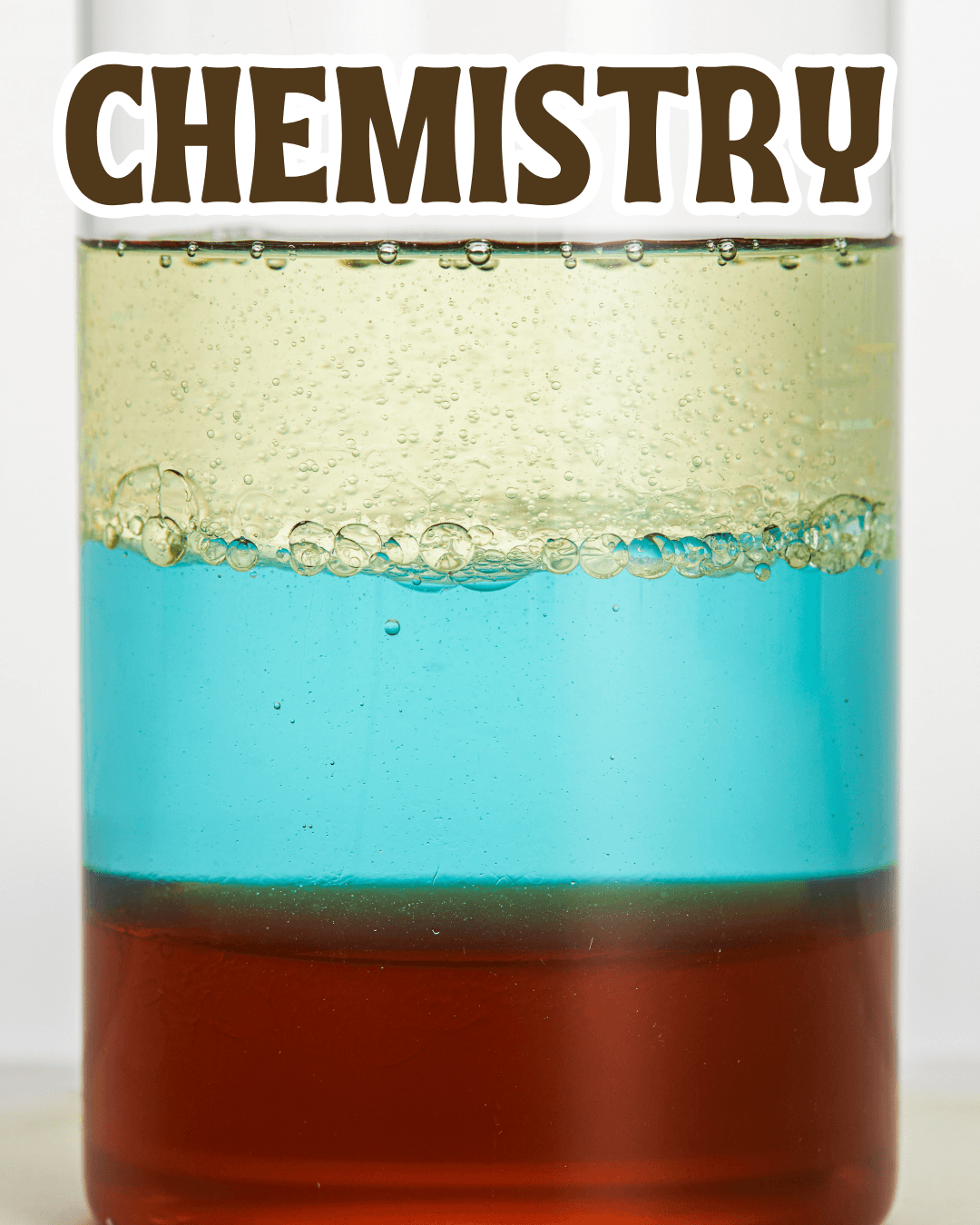
Chemistry: Density, Fluids, & Interactions
Key Concepts: States of matter, mass vs. volume, liquid density tracking, polarity (hydrophobic vs. hydrophilic interactions), and fluid friction (viscosity).
Discover the hidden physics of fluids!
Experiment with molecular weight, create gravity-defying liquid density tubes, and race elements against each other to uncover the secrets of viscosity.Dive into the fascinating world of physical chemistry! In this highly collaborative mobile laboratory experience, a Burpee educator guides students through an interactive exploration of matter. Because this program is focused entirely on chemical and molecular physics, no live animals are involved. Instead, your classroom transforms into an active test kitchen and science lab. Students will investigate the physical traits of matter by stacking polar and nonpolar liquids to build a multi-layered density tube and measuring fluid friction to crack the code of viscosity.
Tactile Specimen Station:: A complete mobile chemistry setup, including graduation cylinders, hydrometer test models, diverse liquid variants , viscosity “race tracks” and drop tubes.
🎓 Curriculum Alignment Matrix (K-8 Grade Tracks)
Our curriculum adaptively shifts terminology, scientific depth, and hands-on activities based on the targeted age group to hit key standard benchmarks:
🧩 Early Learners (Grades K – 2): Heavy, Light, & How Fluids Move. Young students use their senses to observe and compare how different liquids look, feel, and pour. By dropping objects into different liquids and observing how some pour quickly like water while others pour slowly like thick syrup, early learners discover the basic physical rules of the liquids around them.
Core Focus: Identifying properties of matter, floating vs. sinking, and slow vs. fast pouring fluids.
Standards Unlocked & How We Do It:
- K-2-ETS1-2: Testing different objects inside varied liquid cups to compare physical shapes and weight, mapping how properties dictate floating and sinking behaviors.
- 1-PS1-1: Pouring and racing liquids down a track to discover how different fluids maintain unique physical structures and flow speeds.
- 2-PS1-1: Sorting and classifying everyday liquids by their visible behaviors (color, thickness, transparency) to establish baseline groupings of physical matter.
🔍 Elementary Minds (Grades 3 – 5): Liquid Stacking & Molecular Properties. Upper-elementary students dive deeper into the structural traits of liquids. Students engineer a five-layer liquid column by carefully calculating and stacking materials by density, while exploring how water and oil naturally separate due to molecular interactions.
Core Focus: Mass-to-volume relationships, liquid stratification, polarity boundaries (oil vs. water), and fluid drag forces.
Standards Unlocked & How We Do It:
- 3-5-ETS1-3: Executing a structured engineering process to construct a stable, multi-layered density tube using alternating polar and nonpolar liquids (corn syrup, water, oil, and alcohol) without the layers bleeding together.
- 4-PS3-1: Conducting a timed sphere-drop test through varied liquids to measure fluid resistance, mapping how the thickness of a fluid slows down kinetic energy.
- 5-PS1-3: Testing and measuring equal volumes of different liquids to prove that fluids can be identified and classified by their distinct density weights and chemical properties.
🔬 Middle School (Grades 6 – 8): Viscosity Coefficients & Chemical Intermolecular Forces. Middle school students engage in quantitative physical chemistry. They analyze why polarity forces keep specific hydrophobic and hydrophilic liquids from mixing, calculate how temperature shifts alter fluid viscosity, and evaluate how molecular weight dictates buoyancy forces.
Core Focus: Intermolecular forces, hydrophobic vs. hydrophilic behaviors, viscous drag mechanics, measurement accuracy, and thermal impacts on fluid density.
Standards Unlocked & How We Do It:
- MS-PS1-2: Analyzing the clear boundaries between layered liquids in custom density tubes to investigate how chemical polarity prevents polar molecules from bonding with nonpolar substances.
- MS-PS3-4: Tracking and charting sphere descent rates through heated vs. cooled syrups to investigate how thermal energy decreases internal fluid friction and changes viscosity coefficients.
- MS-ETS1-2: Using mass balance measurements and precise volumetric calculations to evaluate fluid behavior, proving how buoyancy principles dictate whether a material sinks, floats, or suspends in a fluid matrix.
Outreach Booking, Pricing & Logistics
The following logistical parameters and pricing models apply uniformly to all Traveling Science Outreach programs listed above. We handle the heavy lifting, bringing the museum’s wonder directly to your location!
Multi-Session Discounts: Planning a full day of science? Booking multiple back-to-back sessions on the same day drops the classroom workshop cost.
Travel Fees: Proudly serving Rockford, the surrounding Winnebago County, and regional school districts. Programs traveling outside a 25-mile radius of the museum may be subject to a minor per-mile mileage surcharge.
How to Book Your Traveling Science Experience
Our school outreach calendar fills up rapidly, especially during spring and fall field season peaks. Ready to secure your date?
Pick Your Modules: Choose from our aligned programs
Contact Our Education Coordinator: Email Nicole Hayes (nicole.hayes@burpee.org)
Have Your Details Ready: Please provide your preferred dates, total estimated student counts, grade tracks (K–12), and physical presentation venue specs.