
The Jay & Barbara Paleo Lab
From Discovery to Research
It takes time, patience, and expertise for fossils to move from the field to the lab—and ultimately to research and public display.
At Burpee, that process begins in the field, where our team carefully excavates fossils and brings them back to the museum for preparation. But discovery is only the beginning.
Back in the lab, fossils are often fragile and encased in dense rock. Burpee’s fossil preparators, skilled in the care and conservation of ancient life, work meticulously to remove the surrounding matrix and reveal the information hidden within each specimen.
Thanks to the Jay and Barbra Brost Paleontology Laboratory, this work happens on-site at Burpee, where preparation, research, and public engagement come together.
The Process
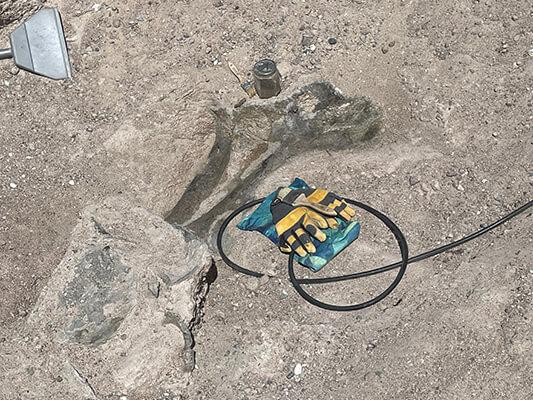
Fossil excavation involves carefully isolating a specimen in the field, stabilizing it, and transporting it back to the museum within its surrounding rock. Once in the lab, preparators use specialized tools and techniques to remove layers of stone and expose fossilized bone—sometimes over months or even years.
Each specimen represents not just a discovery, but an opportunity to learn something new about life on Earth.
Learn About our Field Research
A Living Research Environment
Burpee is not just a place where fossils are displayed—it is a place where they are studied, interpreted, and understood.
Our team works alongside visiting researchers and collaborators, contributing to ongoing scientific work and expanding knowledge through both field and laboratory research. From Montana to Utah, Burpee’s field program continues to uncover new specimens and deepen our understanding of prehistoric ecosystems.
A Lab That Builds Scientists
Burpee’s lab is also a place where people begin and grow their careers in science.
Over the years, students, interns, and volunteers have worked alongside staff in fossil preparation, fieldwork, and research—gaining hands-on experience that shapes their future paths.
Many have gone on to become leaders in paleontology, geology, and related fields.
Professional Paleontological researchers and collaborators began here!
As students, volunteers, or interns…making the Burpee Museum not only a place of discovery, but a place where scientists are made.
Burpee Lab Alumni
Burpee Museum of Natural History is not only home to world famous dinosaurs, but also to world famous Scientists!
Here are just a few of their success stories:
Stephen Brusatte, PhD
School of Geosciences, University of Edinburgh, Scotland
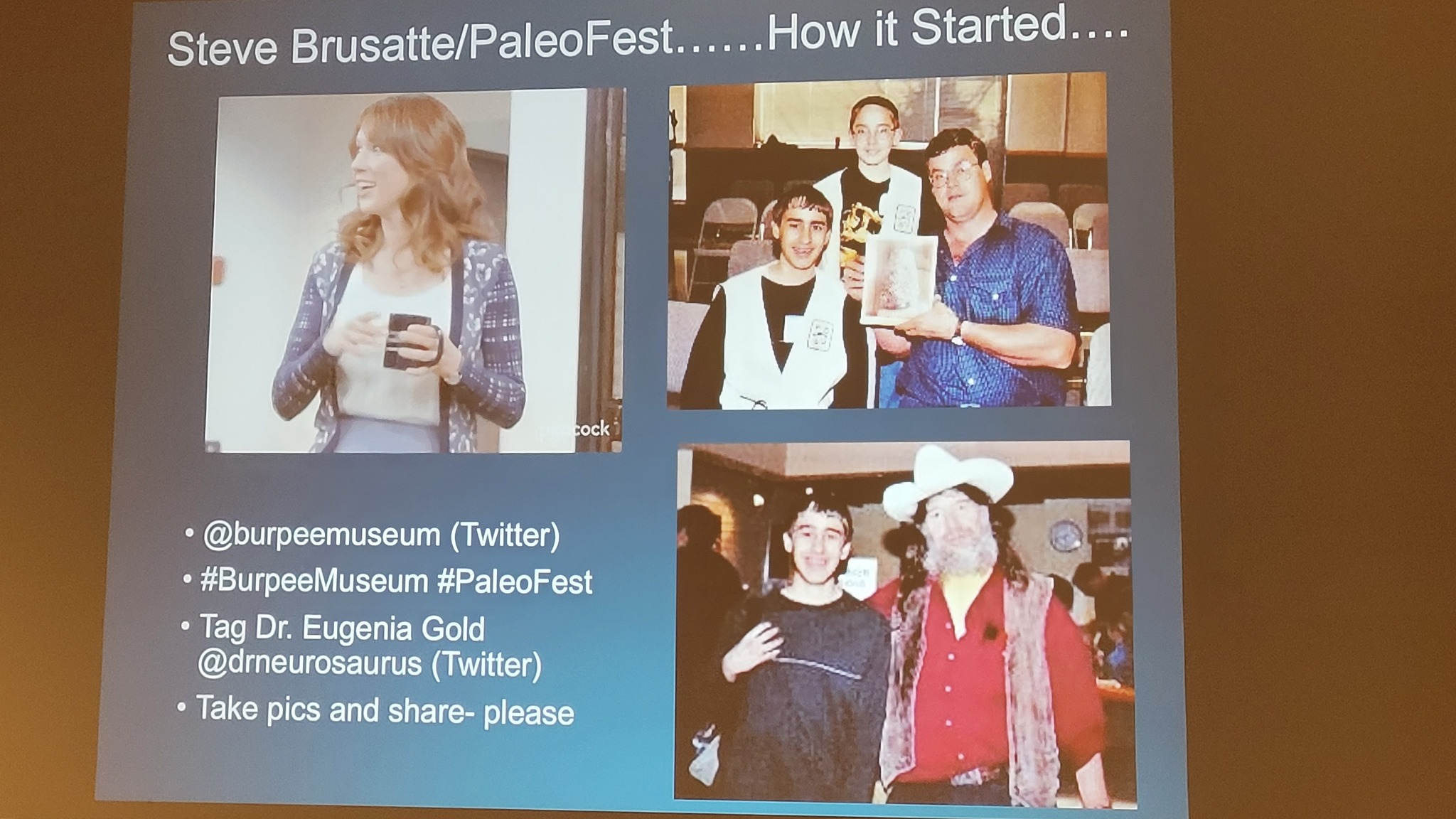
Steve grew up in Northern Illinois and religiously attended PaleoFests while in high school and college and has worked with the Burpee Museum on many field and research projects. Steve has an undergraduate degree from the University of Chicago, Master’s from the University of Bristol, and PhD from Columbia University, where he worked under Mark Norell at the American Museum of Natural History.
Today, Steve Brusatte is on the faculty of the School of GeoSciences at the University of Edinburgh in Scotland. He is a vertebrate paleontologist specializing on the anatomy, phylogeny, and evolution of dinosaurs and other archosaurs, particularly carnivorous theropod dinosaurs and basal archosaurs.
Steve has written over 70 peer-reviewed papers, five books (including the coffee table book Dinosaurs and the textbook Dinosaur Paleobiology), and does fieldwork in North America and Europe.
Joshua C. Mathews, PhD
Josh Mathews began volunteering in the Burpee fossil preparation lab in the fall of 2004 and accompanied them on his first expedition the following summer. It was during this expedition that Burpee’s Triceratops, Homer, was discovered and became the focus of Josh’s Masters research at Northern Illinois University.
In January of 2010, Josh accepted the position of Chief Fossil Preparator and Research Assistant to Dr. Bill Hammer at Augustana College. As part of the Transantarctic Vertebrate Paleontology Project, he was part of an expedition to the Central Transantarctic Mountains, Antarctica. There, the crew completed the excavation of the previously discovered theropod dinosaur Cryolophosaurus. He came back to Burpee in 2016 and continued work on his PhD graduating in 2025.
Anders Carlson, PhD
Associate Professor of Geology and Geophysics, Oregon State University, OR
Anders grew up in Rockford and began volunteering at Burpee Museum while in middle school, which continued through high school. He attended Augustana College, Rock Island IL, for his B.A. in Geology and German, the University of Wisconsin-Madison for his M.S. in Geology, and Oregon State University for his Ph.D. in Geology.
Following a postdoctoral position at Woods Hole Oceanographic Institution, he was an assistant and then associate professor at the University of Wisconsin-Madison from 2007 to 2012. In 2013, he moved to an associate professorship of high latitude climate at Oregon State University.
Anders’ research is on the past responses of ice sheets to climate change, with a goal of determining ice sheet sensitivity to varying degrees of climate warming. He has conducted research in Canada, Svalbard and Greenland, with hopes to extend this study to Antarctica. Anders has received over $2 million in funding from the National Science Foundation and has published numerous articles in such journals as Science and Nature. Learn More on Anders
Joseph Peterson, PhD
Assistant Professor of Geology, UW-Oshkosh, WI
Joseph began at Burpee in 1998 as a volunteer Fossil Preparator. In 2000, he was hired to assist with exhibits and fossil restoration. Additionally, Joseph was also a part of the field crew on the first official Hell Creek expedition in 2001 and assisted with the collection of Jane.
Joseph’s work with Burpee continued on various field expeditions to Montana while working towards his bachelor’s degree in Geology at Southern Illinois University. Utilizing the Burpee collections in his research, Joseph began graduate school at Northern Illinois University in 2005 and graduated with his Doctorate in Geology in 2010.
Today, Dr. Peterson is an Assistant Professor of Geology at the UW-Oshkosh, WI. His research interests include vertebrate paleontology and vertebrate taphonomy, focusing specifically on Late Cretaceous dinosaurs. Dr. Peterson still maintains a strong collaborative relationship with Burpee Museum, both in the field and in research endeavors.
Katie Tremaine, BS
Bozeman, MT
Katie started at Burpee as an intern in 2003, and was hired in 2004 to aid in the preparation of Jane, Burpee’s juvenile T. rex. Katie has worked on many specimens for Burpee, including Hanksville-Burpee dinosaurs, and the Hell Creek specimens Homer the Triceratops, Garny the Triceratops, and an Oviraptor known as Pearl. Katie completed her Associates of Science at Rock Valley College, transferred to Northern Illinois University, and completed her Bachelors of Science there in 2011.
Katie ended her time at Burpee in 2012 as the Chief Preparator, and moved on to become one of Dr. Jack Horner’s Masters students at Museum of the Rockies/Montana State University in Bozeman, Montana. Along with her studies, Katie continues to work as a group leader for Burpee every summer in Utah and Montana, as well as a fossil preparator when she can. She looks forward to a continued association with the museum where she got her start.
Mindy Householder, BS
Head Fossil Preparator, Badlands National Park, SD
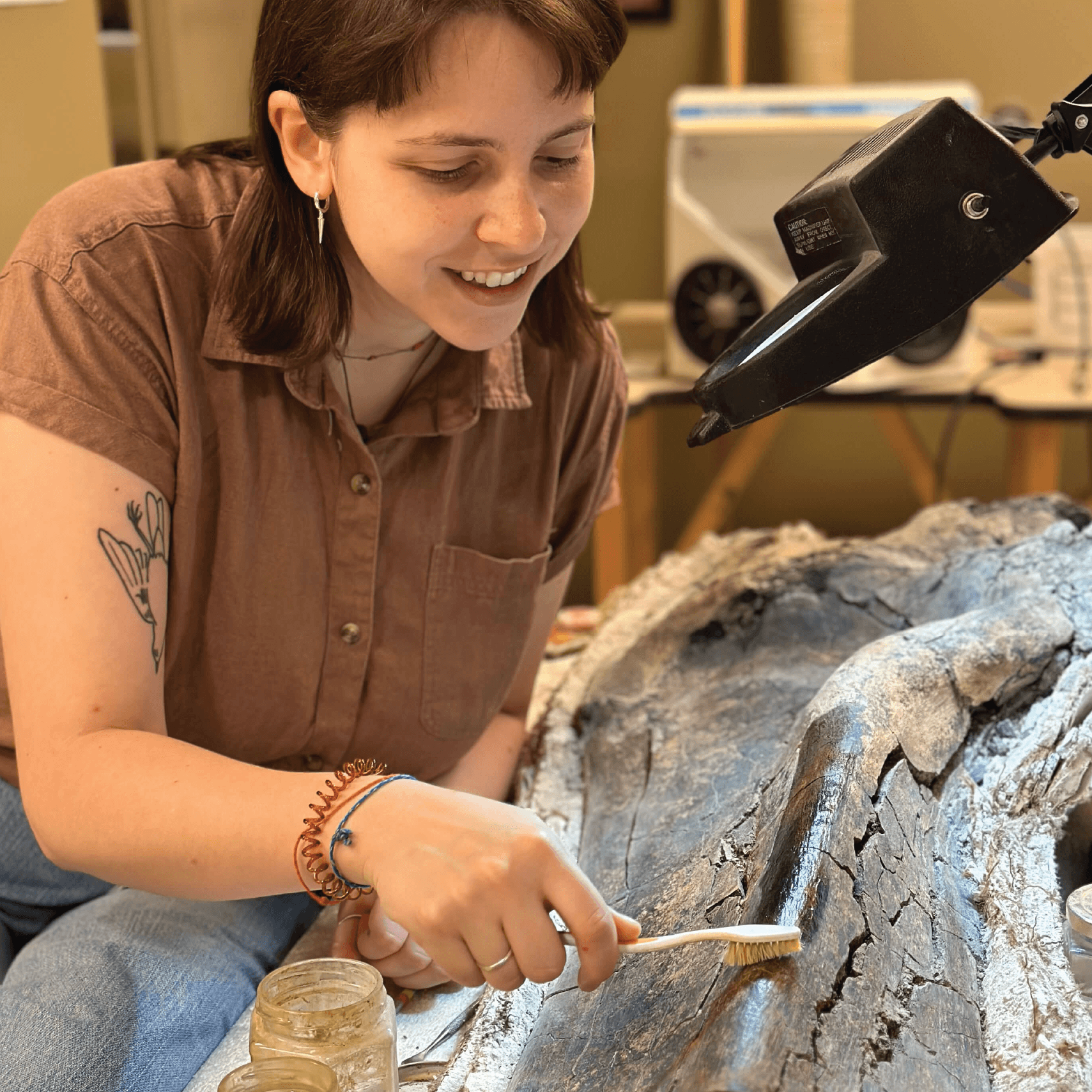
Mindy became an intern at Burpee in 2003, and assisted with the preparation of Jane the following year. During her 8 years at Burpee, Mindy worked on several projects including the preparation of Jane the juvenile T.Rex, Homer the Triceratops, and an unsubscribed Allogatoroid from the Hell Creek Formation of Montana. In 2012, Mindy became the Chief Preparator at Badlands National Park. There, she built the park’s first public viewing lab and designed the park’s fossil preparation protocol and training program. She has worked on several significant fossils, including one of the best preserved skulls of Hoplophoneus.
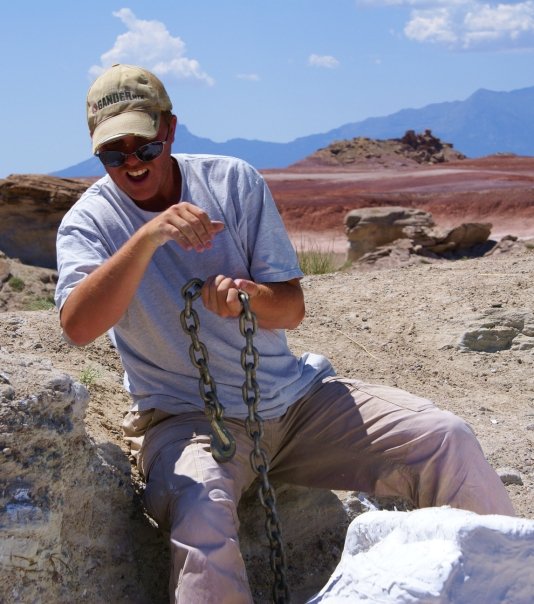
Scott Williams
Bozeman, MT