
Ivory-billed Woodpecker
(Campephilus principalis)
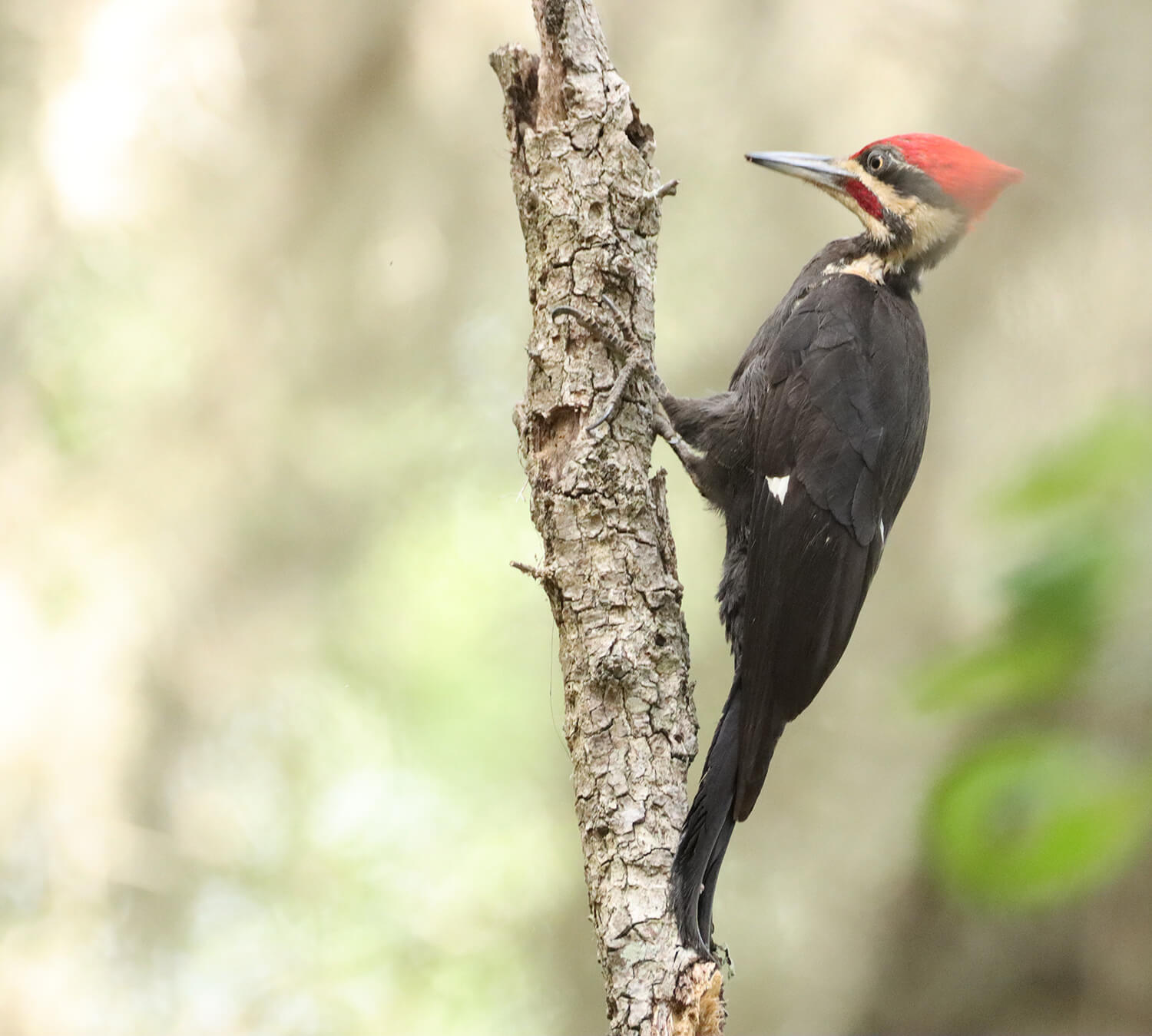
The Ivory-billed Woodpecker—once one of North America’s largest and most striking woodpeckers—inhabited the vast bottomland hardwood forests and cypress swamps of the southeastern United States. Reaching nearly 20 inches in length and recognizably adorned with bold black-and-white plumage and a pale ivory bill, this species was perfectly adapted to life in mature, swampy forests rich in dead and dying trees.
Ecology
Ivory-billed Woodpeckers were highly specialized foragers. They fed primarily on large beetle larvae, prying bark from recently dead trees with their powerful bills. Because this food source was tied to freshly killed or decaying wood, the species required extensive tracts of old-growth forest capable of producing a constant supply of deadwood. Pairs nested high in large dead trees and maintained spacious territories with some spanning several square miles. Their dependence on mature forest structure made them particularly vulnerable to disturbances to their habitat.
Historical Range
The species once occupied a broad arc of the southeastern United States, from eastern Texas across the Gulf Coast through Florida and north into the Mississippi River Valley into southernmost portions of Illinois. As logging intensified in the late 19th and early 20th centuries, their range rapidly dwindled, leaving the species confined to remnant swamp forests.
Conservation Status
Relentless logging of old-growth forests combined with hunting and specimen collecting drove the Ivory-billed Woodpecker into steep decline. The last widely accepted U.S. sighting occurred in 1944. Despite occasional unconfirmed reports and periodic search efforts, no definitive evidence of surviving individuals has been found in decades.
Today the species is regarded as Critically Endangered, however presumed extinct. Its story stands as a powerful reminder of the fragility of specialized species and the ecological importance of protecting mature, intact forest ecosystems. Ongoing conservation of remaining bottomland forests continues both as a tribute to this iconic bird and in hope that, if any individuals persist, the habitat they depend on will endure.