
Passenger Pigeon
(Conuropsis carolinensis)
Once the most abundant bird in North America and possibly the world, the Passenger Pigeon traveled in enormous flocks that darkened the sky for hours as they passed overhead. These sleek, fast-moving birds were a defining feature of Eastern North American forests, shaping ecosystems through their sheer numbers.
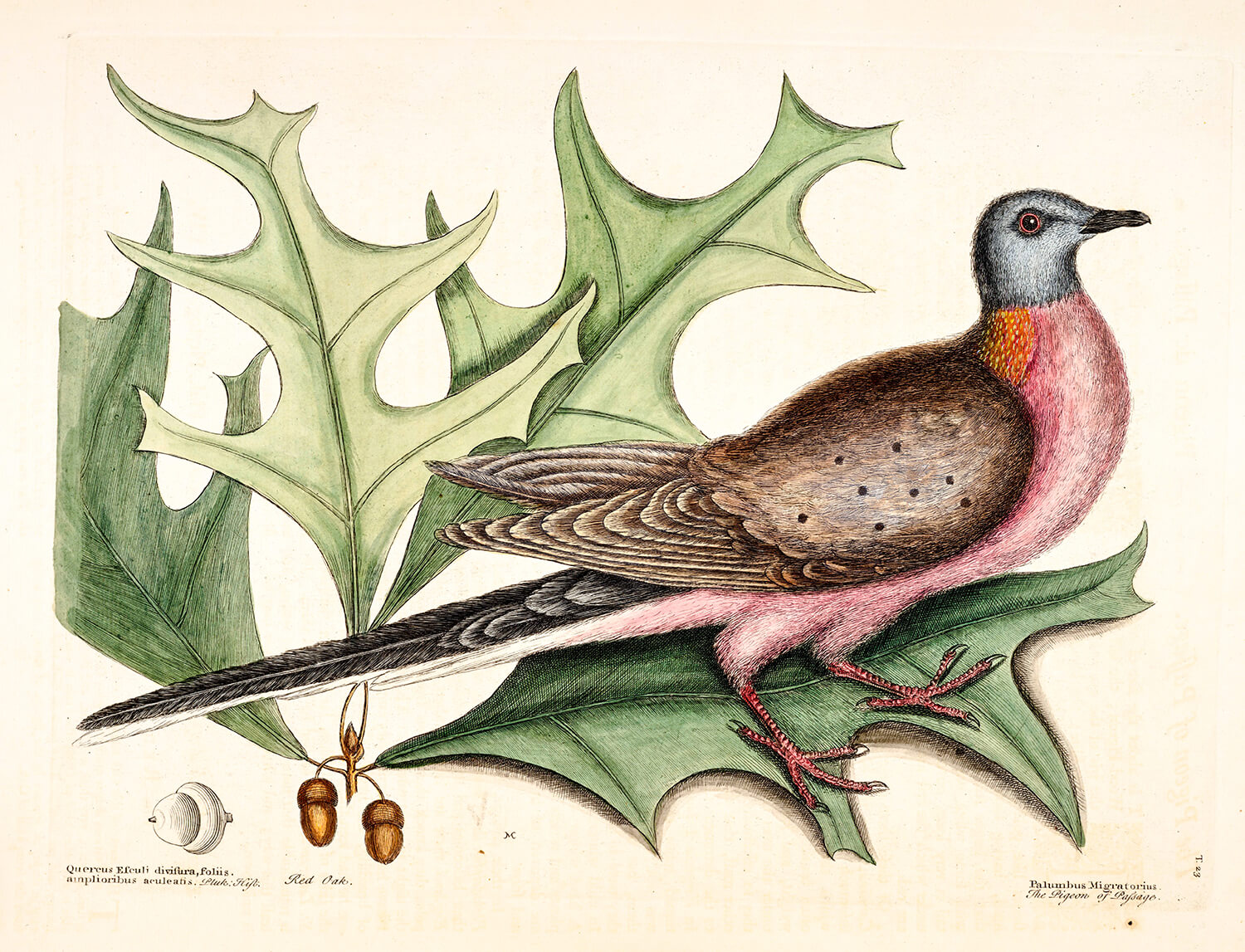
Ecology
Passenger Pigeons lived primarily in vast deciduous forests, feeding on acorns, chestnuts, beechnuts, berries, and seeds. Their social structure was extreme: they nested, roosted, and migrated in huge colonies, with millions of birds crowded into small areas.
Flocks often broke branches or stripped trees bare, creating habitat patches that benefited other species. Their presence influenced forest regeneration patterns, making them a keystone species long before the concept existed.
The pigeons were swift, powerful fliers capable of reaching speeds around 60 miles per hour and relied on massive flocking for protection against predators.
Historical Range
Passenger Pigeons occupied eastern and central North America, from the Atlantic Coast to the Great Plains and from the Gulf Coast to southern Canada. The greatest concentrations occurred in the Ohio River Valley and the Great Lakes region, where extensive forests provided abundant food and nesting grounds.
Their migrations were unpredictable, driven by changes in nut production, leading them to appear in great numbers one year and vanish from the same area the next.
Causes of Decline
The species’ downfall was astonishingly rapid, occurring within just a few decades in the 19th century:
- Industrial-scale hunting: The development of railroads and telegraphs allowed hunters to locate and exploit large nesting colonies efficiently.
- Market demand: Billions of birds were shipped to cities as cheap food.
- Habitat destruction: Widespread clearing of eastern forests eliminated essential feeding and nesting sites.
- Social collapse: Passenger Pigeons depended on large flock sizes for successful breeding; as numbers fell, reproduction plummeted.
By the 1890s, wild populations had collapsed beyond recovery.
Extinction
The last confirmed wild Passenger Pigeon died in 1901. The final individual, Martha, lived at the Cincinnati Zoo until her death in 1914. Her passing marked the end of a species that once numbered in the billions.
The extinction of the Passenger Pigeon is one of the most dramatic examples of how abundant species can vanish when faced with unregulated exploitation and habitat loss. It transformed conservation policy in North America, spurring early wildlife protection laws and influencing the eventual creation of the Migratory Bird Treaty Act.
Today, the Passenger Pigeon stands as a powerful symbol of both ecological interdependence and the consequences of unchecked human activity, reminding us that even the commonest species are not guaranteed a future.