
Jane: NOT a juvenile Tyrannosaur??
…changing how we see T. rex
Quick Info:
Rockford’s world-famous tyrannosaur fossil, Jane, may not be a T. rex after all!
A new study published in Nature by Dr. Lindsay Zanno and Dr. James Napoli has identified Jane as a new species — Nanotyrannus lethaeus — revealing that more than one top predator may have ruled the Late Cretaceous! !
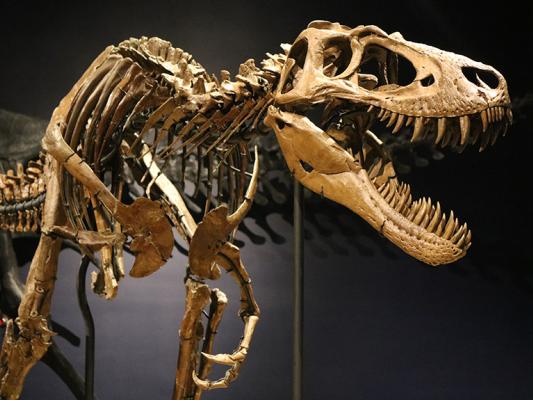
Jane on display at Burpee Museum in Rockford, Illinois
Jane’s Story
In 2001, a nearly complete skeleton of a small tyrannosaur was unearthed near Ekalaka, Montana, by researchers from the Burpee Museum of Natural History in Rockford, Illinois. This fossil, nicknamed “Jane,” quickly became one of the most significant tyrannosaur discoveries of the early 21st century. Measuring about 21 feet (6.4 meters) long and standing roughly 7 feet (2 meters) tall at the hips, Jane was not the towering predator often associated with Tyrannosaurus rex. Instead, she represented a younger, more agile phase in the life of these iconic dinosaurs, or possibly even a different species altogether. Her discovery has provided critical insight into how tyrannosaurs grew, hunted, and evolved.
“If Jane is truly Nanotyrannus lethaeus, she’s the only one of her kind ever found, that makes her scientifically priceless — a once-in-a-lifetime discovery.” Dr. Joshua Mathews.
“Jane is an extraordinary specimen–not just scientifically, but as a point of pride for Rockford,”
said Dr. Joshua Mathews, VP of Research and head of paleontogy at the Burpee Museum of Natural History. “She was discovered, excavated, and prepared by the people of this community, and she continues to shape our understanding of the Cretaceous world. It’s incredible that a fossil found and prepared through Burpee’s research program has remained at the center of one of paleontology’s most exciting debates for over 25 years. With this new discovery, Jane’s importance will continue for decades to come as scientists work to piece together the complex story of the last great age of dinosaurs.”
“We’ve always known Jane was special,”
said Anne Weerda, Executive Director of the Burpee Museum. “Now the world knows just how unique she may be. Whether Jane represents the best-preserved juvenile T. rex or the only known specimen of a brand-new species, she is truly one of a kind — and she calls Rockford home.”

Discovery and Description
Jane’s skeleton was found in rocks belonging to the Hell Creek Formation, a dinosaur-rich unit that dates to the very end of the Cretaceous Period, about 66 million years ago. The specimen is about 50–60% complete, with an exceptionally well-preserved skull and numerous postcranial bones. Her fine, slender bones and long legs suggest she was a fast runner, possibly adapted to chase smaller prey rather than the massive herbivores that adult tyrannosaurs pursued.
Initial Debating:
At first, scientists debated whether Jane was a juvenile Tyrannosaurus rex or a member of a smaller, closely related species called Nanotyrannus lancensis. The controversy stems from the fact that smaller tyrannosaur skulls, like Jane’s, look quite different from adult T. rex skulls, with more gracile proportions, sharper teeth, and a lighter build. However, subsequent studies using bone histology, the microscopic study of bone tissue, have revealed that Jane was likely around 11–13 years old when she died, still growing and not yet fully mature. This evidence supported the idea that Jane was indeed a young Tyrannosaurus rex rather than a separate species.
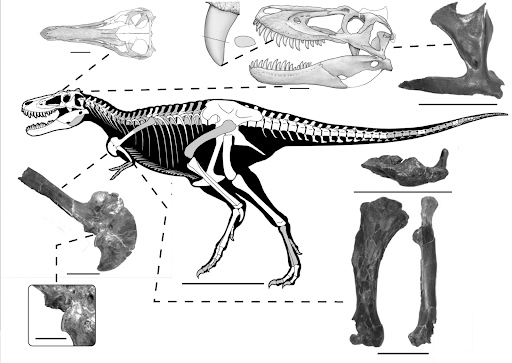
Skeletal drawing of Jane highlighting juvenile characteristics. White bones show are preserved. From: Williams, S., S. Brusatte, J. Mathews and P. Currie, 2010.
What Jane taught science:
Jane’s discovery helped revolutionize the understanding of tyrannosaur growth and behavior. Before her find, scientists knew little about how T. rex developed from hatchling to apex predator. Jane helped fill that gap, showing that young tyrannosaurs underwent dramatic changes in body structure, hunting style, and ecology as they aged.
Growth and Development:
Jane’s bones show signs of rapid growth, suggesting that T. rex went through a teenage “growth spurt,” during which individuals could gain hundreds of pounds each year. This insight revealed that T. rex had one of the fastest growth rates of any known dinosaur.
Hunting and Behavior:
The lightweight frame and long limbs of juvenile tyrannosaurs like Jane imply that they occupied a different ecological niche from adults. Rather than competing for the same food, young tyrannosaurs likely hunted smaller prey and relied on speed and agility, while adults used brute force to take down larger animals.
The Nanotyrannus Debate:
Jane continues to sit at the heart of one of paleontology’s longest-running debates. If Jane and similar specimens are indeed juvenile T. rex, then Nanotyrannus is not a valid species. But if they are distinct, it would mean two species of tyrannosaurs coexisted in North America at the end of the Cretaceous. While most modern analyses support the juvenile T. rex hypothesis, the discussion continues, illustrating how a single fossil can reshape scientific thought.
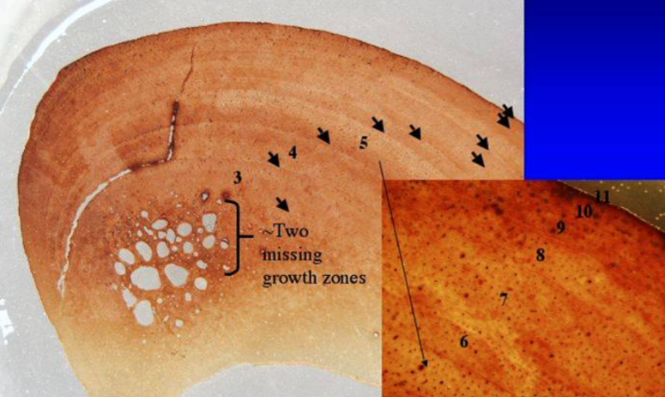
Osteohistological slide of Jane showing growth rings. Arrows point to each ring. Photo courtesy of Greg Erickson.
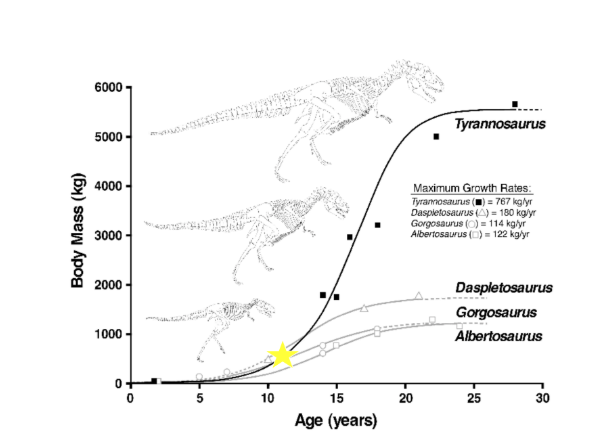
The previously described growth curve of Tyrannosaurus rex. Because of the newly resurrected Nanotyrannus lancensis, growth studies for T. rex will need to be re-evaluated, removing Nanotyrannus specimens from the analysis.
New study upends T. rex research and reignites the Nano-T. rex debate!
A new paper by Burpee colleagues, Dr. Lindsay Zanno and Dr. James Napoli has just been published which ends the debate about the validity of Nanotyrannus lancensis! Nano is real!!!! The “dueling dinosaurs”, a tyrannosaur and Triceratops buried together from the Hell Creek Formation of Montana, are on exhibit at the North Carolina Museum of Natural History. The small tyrannosaur is 100% complete and their research has concluded that the animal is an adult and different from Tyrannosaurus rex! This skeleton is also the same species as the famous “Cleveland Skull” that was collected from Carter County, Montana in 1942 and described as Nanotyrannus lancensis in 1988 by Bob Bakker and colleagues. When Burpee’s juvenile tyrannosaur was originally discovered, it was initially thought to be that of Nanotyrannus. Further analysis led researchers to argue that Jane and the Cleveland skull likely belonged to a juvenile T. rex rather than a new species, based on histological evidence showing Jane to be a young animal and still growing rapidly. This conclusion was turned upside down by the new paper, not only stating that Jane was a Nanotyrannus, but a new separate species, Nanotyrannus lethaeus! The interesting thing is that Jane is definitely a juvenile animal, which the authors agree, so how much bigger would N. lethaeus, Jane, get and what did an adult look like? Furthermore, with all of the smaller specimens that were thought to be young T. rexes, now thought to be Nanotyrannus, what does a young T. rex look like?
What a great day for science!
This is a debate that has been ongoing for decades and the cliche saying that “we need more specimens” to answer that question just proved that with this new specimen. Tyrannosaur researchers who have long disagreed with the validity of Nanotyrannus have rallied around Zanno and Napoli in support of their conclusion, accepting that their previous thoughts were incorrect based off of this new specimen in North Carolina. That is how science works! Conclusions are based on the evidence at hand, knowing that future evidence could lead to a change. Most of the researchers on the “side” of juvenile T. rex were not of the mind that Nanotyrannus would never be valid, it was that the evidence that they currently had supported the juvenile hypothesis better than Nanotyrannus. The dueling dinosaur tyrannosaur clearly shows that at least one other large-bodied predator, maybe more, inhabited Hell Creek ecosystems 66 million years ago!
Legacy and continuing research
Today, Jane is housed at the Burpee Museum of Natural History, where she remains one of the best-preserved juvenile tyrannosaurs ever discovered. She has been featured in traveling exhibitions and scientific conferences, inspiring both paleontologists and the public. Ongoing studies using CT scans and 3D modeling continue to extract new data from her bones, deepening our understanding of tyrannosaur anatomy and evolution.
Conclusion
Jane’s discovery represents more than just another dinosaur fossil, it is a window into the life stages of one of Earth’s most famous predators. Through her, scientists continue to learn how Tyrannosaurs grew from a swift, slender hunter into a colossal apex predator. Whether viewed as a young T. rex or as a new species of Nanotyrannus, Jane remains a cornerstone in paleontological research and a vivid reminder that even the fiercest creatures began life as something smaller, faster, and just as fascinating.