
Greater Prairie-Chicken
(Tympanuchus cupido)
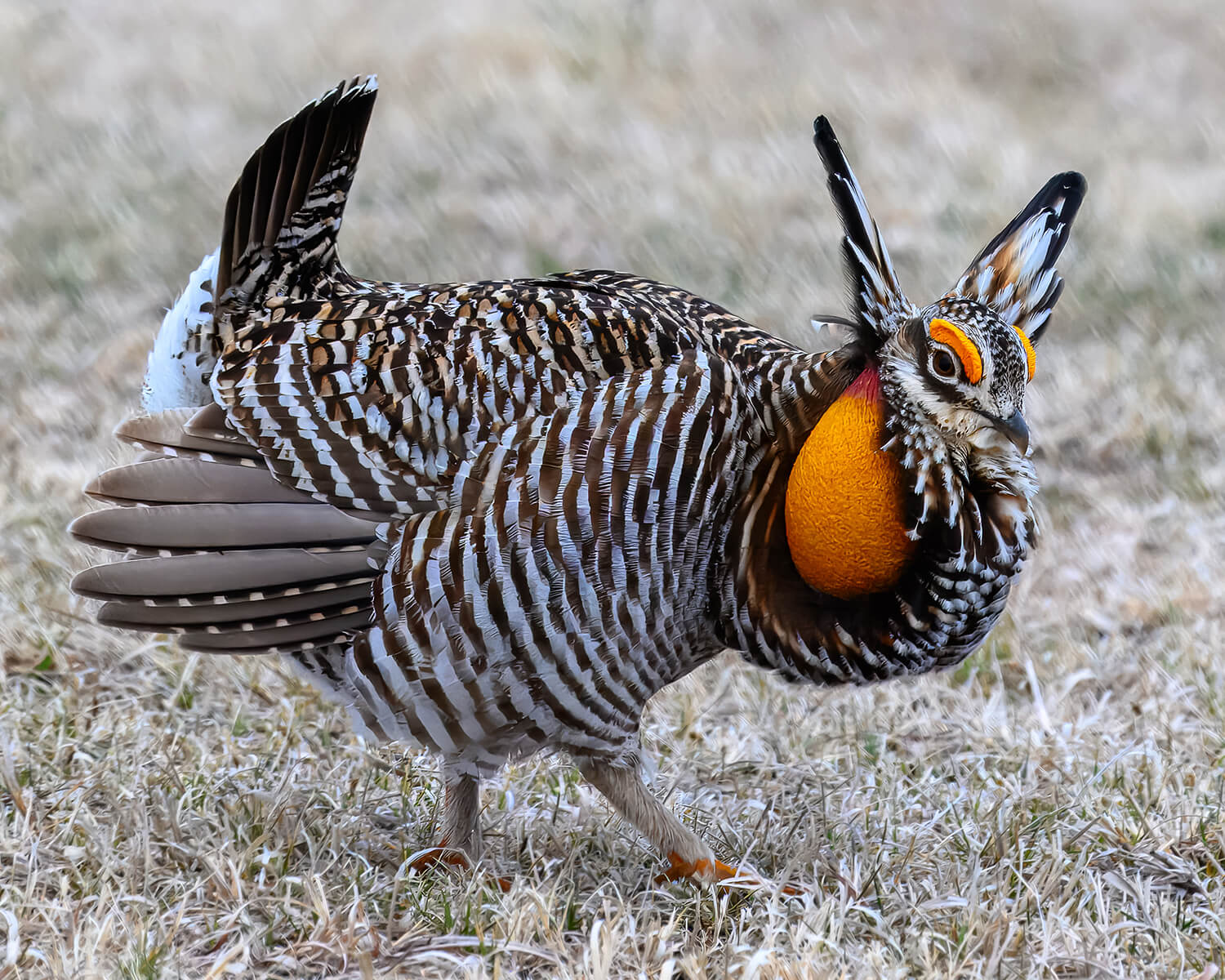
Once a defining species of North America’s tallgrass prairies, the Greater Prairie-Chicken is known for its dramatic spring displays, when males gather on “leks” to boom, stomp, and raise their brightly colored neck sacs in competition for mates. Today the species survives only in fragmented remnants of the vast grasslands it once dominated.
Ecology
Greater Prairie-Chickens depend on large, unbroken tracts of native prairie. They use:
- Open grasslands for booming displays and nesting
- Dense vegetation for brood rearing
- Mixed-height prairie for feeding on seeds, insects, and tender shoots
Their survival hinges on a mosaic of prairie plants and grasses shaped by fire, grazing, and seasonal change. Chicks rely heavily on insect-rich habitats, making healthy prairie invertebrate communities essential.
Historical Range
Historically, the Greater Prairie-Chicken inhabited a broad sweep of tallgrass prairie from Ohio and Indiana across Illinois, Iowa, Missouri, and Kansas into the Great Plains.
In Illinois, the species was once abundant, but as prairie was converted to cropland, populations collapsed. By the mid-20th century, only a few small groups remained, mostly in the sand prairie and grassland regions of the southeastern and central parts of the state.
Conservation Status
The Greater Prairie-Chicken is listed as Endangered in Illinois, with only a few small flocks persisting today. Critical threats include:
- Loss and fragmentation of native prairie habitat
- Declining genetic diversity in isolated populations
- Predation pressure in reduced habitats
- Changes in land management, such as fire suppression
Because the species requires large, continuous grasslands, even well-managed patches may be too small to support stable populations without broader landscape connectivity.
Conservation Efforts
Illinois conservationists are working to restore and expand prairie landscapes through:
- Habitat restoration and prescribed fire
- Translocations from healthier populations in other states to boost genetic diversity
- Landscape-level management to reconnect fragmented grasslands
These efforts aim not only to save the species but also to revive the tallgrass prairie ecosystem that once covered much of the state.
A Living Icon of the Prairie
The Greater Prairie-Chicken is both a symbol of the tallgrass prairie and a reminder of how swiftly ecosystems can vanish. Its booming calls, once heard across thousands of square miles, now persist in only a few protected landscapes. Protecting the prairie-chicken means preserving one of North America’s most endangered and most spectacular natural heritage systems.