
Northern Curlew
(Numenius borealis)
The Northern Curlew, formerly known as the Eskimo Curlew, was once one of North America’s most numerous migratory shorebirds. Small, swift, and long-winged, this curlew was celebrated for its extraordinary long-distance migrations, traveling from Arctic breeding grounds to wintering habitat in South America.
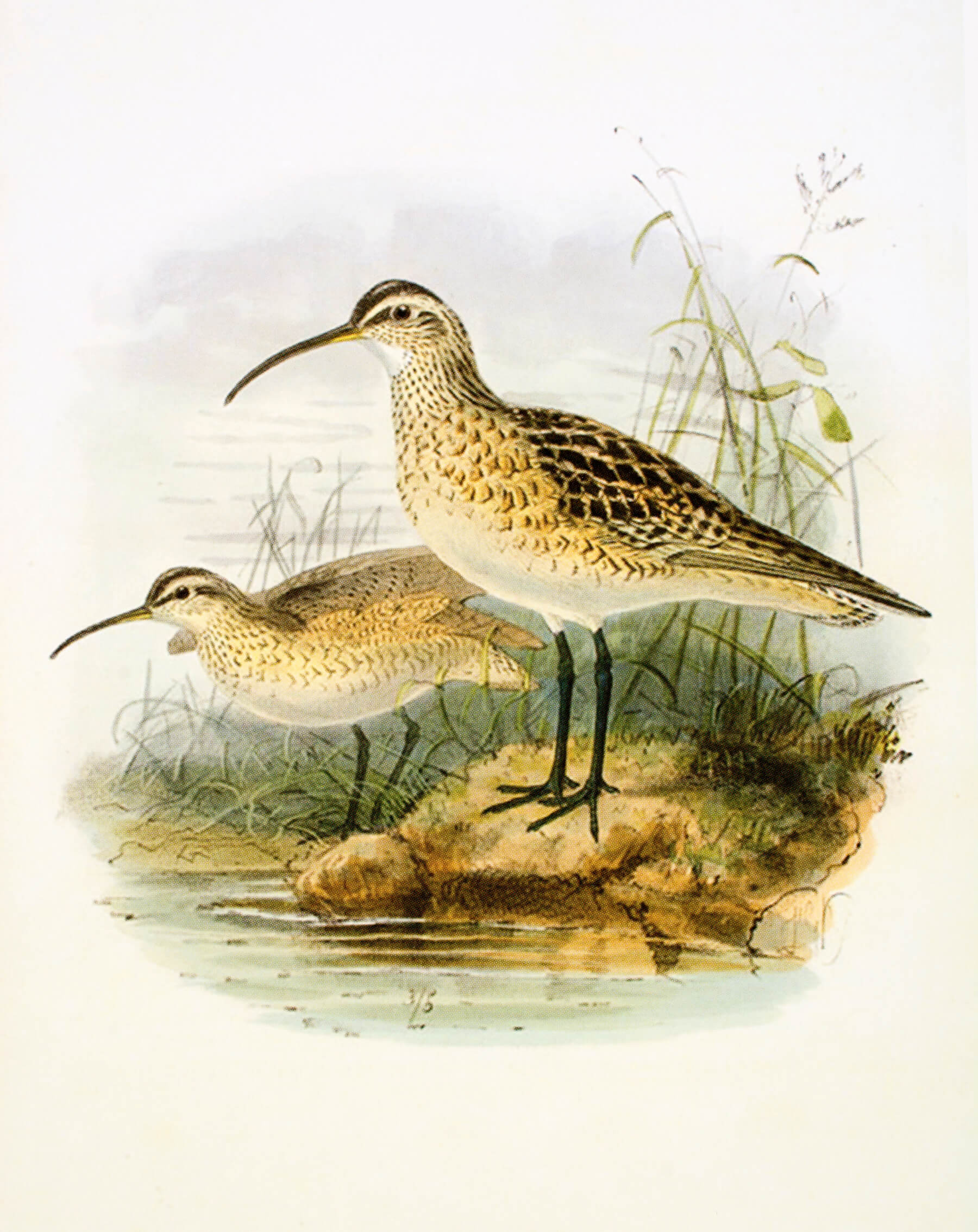
Ecology
Northern Curlews bred in the open tundra of northern Canada and Alaska, nesting in shallow scrapes on the ground. In summer, they fed on insects, especially beetles and grasshoppers taken from tundra vegetation and muskeg.
During migration, immense flocks stopped on the Great Plains, where they fed heavily on Rocky Mountain locusts, a once-abundant insect that formed a major part of their diet. Their long, slightly down-curved bills allowed them to probe soil, pick insects from vegetation, and forage efficiently in a range of open habitats.
In winter, the species traveled to the grassy pampas and coastal plains of Argentina, Uruguay, and southern Brazil, completing one of the most impressive migration circuits of any American bird.
Historical Range
The Northern Curlew followed a vast migration route:
- Breeding: Arctic tundra of northwest and central Canada
- Southbound migration: Great Plains, central North America, Gulf Coast
- Winter: Grasslands and coastal plains of southern South America
- Northbound migration: Mostly over the western Atlantic, with stopovers in the Caribbean and northeastern South America
Historic accounts describe immense flocks passing through the prairies—so numerous that early observers compared them to the migrations of Passenger Pigeons.
Causes of Decline
The species’ rapid collapse in the late 19th century stemmed from multiple human-driven factors:
- Market hunting: The curlew was heavily hunted during migration, particularly on the Great Plains where flocks gathered in large numbers.
- Loss of key food source: The extinction of the Rocky Mountain locust—once numbering in the trillions—greatly reduced a primary food resource during migration.
- Habitat conversion: Widespread plowing of prairies removed stopover areas essential for refueling on long flights.
- Vulnerability of migration patterns: Like many migratory species, the curlew depended on a chain of intact habitats; disruption of any link had far-reaching effects.
By the early 1900s, sightings had become rare.
Conservation Status
The Northern Curlew has not been conclusively documented for decades. The last widely accepted specimens were taken in the early 20th century, and the last strongly credible sightings occurred in the mid-to-late 20th century. Despite occasional reports, no confirmed breeding or wintering populations have been found.
The species is now considered Critically Endangered and likely extinct, though not yet officially declared due to the possibility that a few individuals may persist in remote Arctic regions.
Legacy
The disappearance of the Northern Curlew highlights the vulnerability of migratory species whose survival depends on the integrity of multiple ecosystems across continents. Its story mirrors that of other lost North American birds and underscores the importance of protecting migration corridors, conserving grasslands, and understanding the cascading effects of ecological change.
The Northern Curlew remains a poignant symbol of the prairies, an emblem of vast migrations that once defined the North American landscape.